Atlantic City Airport (ACY): The Little Airport With a Surprisingly Big Story
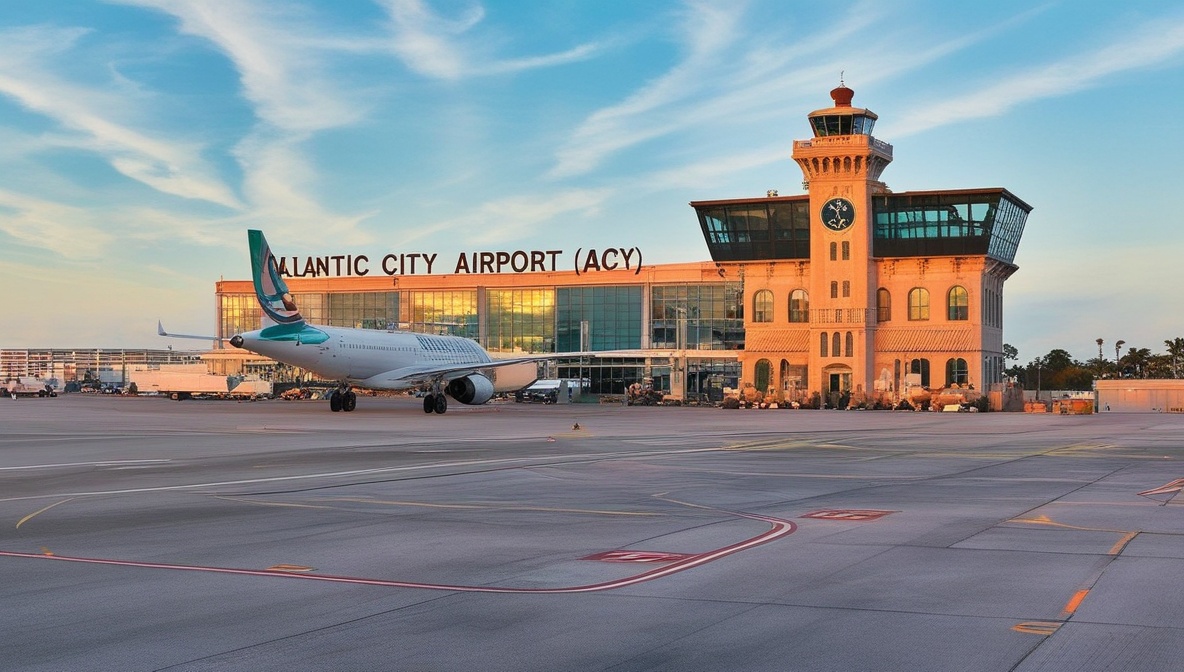
Most people think of Atlantic City as a place of boardwalks, casinos, and the smell of salt air rolling in off the ocean. But tucked about nine miles inland from all that glitter, sitting in the flat pine-scented land of Egg Harbor Township, there is an airport that carries its own kind of quiet magic.
Atlantic City International Airport — most people just call it ACY — is not a massive hub. You won’t find it mentioned in the same breath as JFK or O’Hare. But spend a little time learning about it, and you start to realize that this modest regional airport sits at the very center of something genuinely extraordinary. It is home to fighter jets, one of the most important aviation research labs in the world, a Coast Guard air station, and a passenger terminal that thousands of people move through every year without ever knowing what is happening just beyond the fence.
Let’s slow down and take a proper look at this place — its past, its present, and the quietly exciting things being planned for its future.
Key Facts
| Category | Details |
| Official Name | Atlantic City International Airport |
| IATA Code | ACY |
| Location | Egg Harbor Township, New Jersey |
| Distance from Atlantic City | Approximately 9 miles (14 km) northwest |
| Total Land Area | Over 5,000 acres |
| Runways | Two |
| Terminal | Single terminal, two levels, 10 gates |
| Operated by | South Jersey Transportation Authority (SJTA) |
| Major Airline Tenant | Spirit Airlines (primary), plus Allegiant, Breeze, American Airlines |
| Annual Passengers (2024) | Approximately 1,042,348 |
| Opened as Civil Airport | 1992 (SJTA took over terminal) |
| Original Use | U.S. Naval Air Station, commissioned 1943 |
| Key Co-tenant | FAA William J. Hughes Technical Center |
| Military Presence | 177th Fighter Wing (“Jersey Devils”), NJ Air National Guard; U.S. Coast Guard Air Station |
| Airport Expressway Access | Atlantic City Expressway, Exit 9 |
Where It All Started: A Racetrack, a Navy Base, and a World War
Here is something that might surprise you. Before this land was ever an airport, people drove horses and automobiles around it in circles. Around 1915, the property was used as a racetrack. Nobody racing around that oval could have imagined that within three decades, fighter pilots would be screaming over the same patch of South Jersey pine barrens.
The story of ACY really begins in 1940, when Atlantic City bought more than 4,300 acres of land with the idea of building a proper modern airport. The older Bader Field — the scrappy little airstrip sitting right in the city, almost on the water — had served its purpose. But the world was changing fast. Europe was already at war.
Construction on the new site began in 1941. The federal Works Progress Administration kicked in money and workers to help clear the trees and pour the concrete. Then America entered the war, and everything changed again. The U.S. Navy saw this half-finished airport and recognized exactly what it needed. They leased it from the city, and on April 24, 1943, Naval Air Station Atlantic City was officially commissioned.
For the next several years, this field trained thousands of aviators. Young men came here to learn fighter tactics — low-altitude gunnery, high-altitude combat, night flying, carrier landings practiced on dry land. Torpedo squadrons drilled. Bomber crews prepared. A Combat Information Center operated here that was, in its own way, a precursor to the air traffic control systems we rely on today.
When the war ended, the mission shifted. The Navy eventually wound things down and officially shut the base in 1958. But this land was too useful to sit empty.
See also”Jack Ryan Movies: A Friendly Guide to Every Movie and Why He’s Stuck Around So Long“
From Navy Base to FAA Headquarters: A Remarkable Second Life
When the Navy left in 1958, Atlantic City held the deed to all those acres. But rather than develop it or sell it off piecemeal, the city transferred most of the property to the federal government — specifically to what would become the Federal Aviation Administration — for the remarkable price of $55,000. The city kept 84 acres for itself.
The FAA turned those former Navy buildings and runways into something no one had quite built before: a national aviation research laboratory. They called it the National Aviation Facilities Experimental Center, or NAFEC. Scientists and engineers moved in. They started testing radar systems, experimenting with air traffic control software, and working on ways to make American skies safer and more organized.
Those humble wartime buildings eventually gave way to something much larger. In 1980 a massive new headquarters building was dedicated — a sprawling complex named after Chuck Yeager, the first pilot to break the sound barrier. The lab was renamed the FAA Technical Center. And in 1996, it earned its current name: the William J. Hughes Technical Center for Advanced Aerospace, honoring the New Jersey congressman who fought hard to keep the facility in Atlantic City when there were real fears it might be relocated.
Today the Technical Center covers those same 5,000-plus acres and houses around 250 buildings. There are 500,000 square feet of laboratory space inside those buildings. About 3,000 scientists, engineers, researchers, and support staff come to work here every day, doing things that affect every commercial flight in America — testing new air traffic control software, studying cybersecurity threats to aviation systems, working on the integration of drones into shared airspace, and developing the tools that will shape flight for the next generation. Every significant improvement to the U.S. national airspace system since 1958 has been developed or tested in this place. Carrying that is a big task.
The Jersey Devils Are Here Too
Pull back from the research labs and look across the airfield on a clear morning. There is a good chance you will hear a roar that rattles your chest before you see anything. That is an F-16 Fighting Falcon climbing hard.
The 177th Fighter Wing of the New Jersey Air National Guard has called this airport home since 1958 — the same year the Navy left. Known by their call sign the “Jersey Devils,” this unit is responsible for protecting American airspace over the Northeast. They fly the F-16C/D Fighting Falcon. They scramble when civilian aircraft stray off course. They have deployed to conflicts around the world. They ran air defense missions after September 11 as part of Operation Noble Eagle.
There is a story from February 1998 that captures what these pilots do. Two 177th jets were scrambled to intercept a small private plane that had gone badly off course and was drifting out to sea. The fighter pilots pulled up alongside the confused pilot, lit their afterburners, flashed their lights — doing everything they could to get his attention without a radio connection. It worked. The private pilot turned around. The 177th escorted him safely back to Atlantic City International Airport. No drama in the news. Just two pilots doing their job on a winter afternoon over the cold Atlantic.
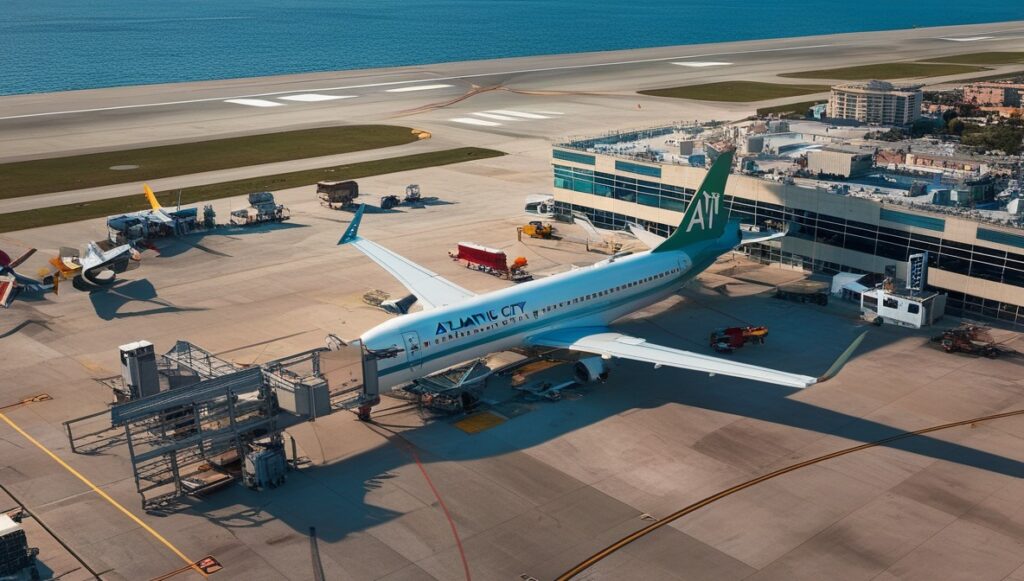
The U.S. Coast Guard also keeps an air station here, operating HH-65 Dolphin rescue helicopters. So at any given moment, the skies above ACY might hold a Spirit Airlines Airbus on final approach, an F-16 banking steeply off the runway, and an orange-striped Coast Guard helicopter heading out on a search-and-rescue mission over the water. Try finding that combination anywhere else.
The Passenger Side: Small Airport, Big Advantages
Now here is the part that matters most to the person who just wants to catch a flight to Orlando without losing their mind.
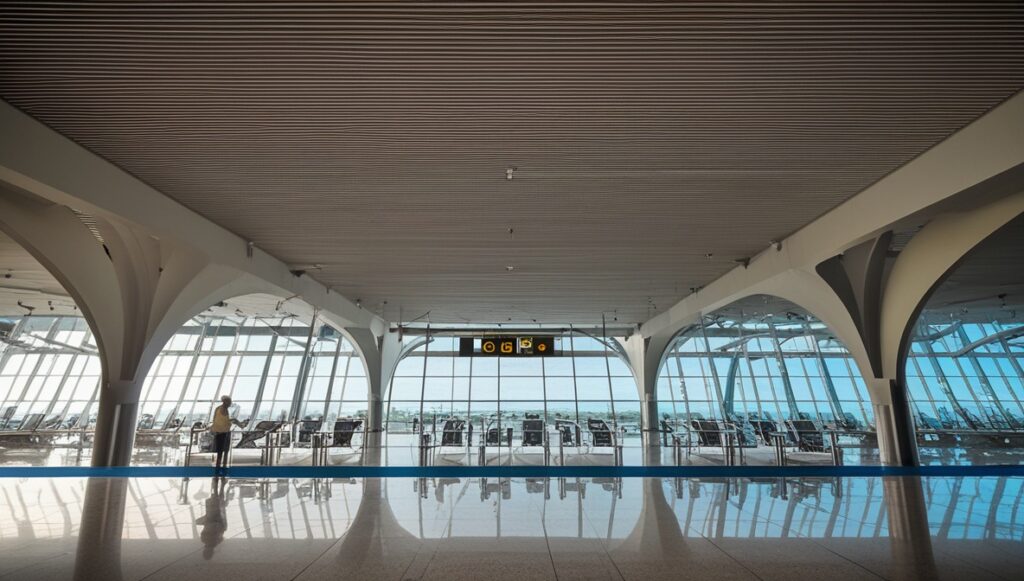
ACY is a small airport. One terminal. Two levels. Ten gates. Arrivals come in on the lower floor; departures go out from the upper floor. That is the whole layout. When you land here, baggage claim is a short walk from the gate. When you leave, you clear security quickly — locals often say an hour before departure is plenty — and you are at your gate before you have had time to finish your coffee.
For years Spirit Airlines anchored the passenger operation here, launching scheduled service in 1992. Spirit remains the biggest commercial presence, with routes running regularly to warm-weather destinations like Orlando, Fort Lauderdale, Tampa, and Myrtle Beach. Allegiant Air, Breeze Airways, and American Airlines have also offered or expanded service. The airport handles around a million passengers per year — roughly the 100th busiest in the country by traffic, which puts it solidly in the “busy regional” category.
The airport is reached easily via the Atlantic City Expressway at Exit 9. From the terminal to the Atlantic City Boardwalk takes about 12 minutes by car. For those without wheels, NJ Transit bus routes connect the airport to downtown Atlantic City and to Hammonton. A free shuttle runs to the Egg Harbor City rail station, where you can catch trains toward Philadelphia. Taxis and rideshare pickups are organized outside baggage claim.
Parking at ACY is straightforward. There is a garage, a short-term lot, and a more affordable economy lot. As of January 2024, all parking went fully cashless — credit cards and EZPass only. A free cell phone waiting lot sits less than half a mile from the terminal for people picking up arriving passengers. Economy lot rates run about $12 per day, which is significantly cheaper than comparable options near Philadelphia International or Newark.
What It Feels Like to Fly Through ACY
People who fly through ACY regularly tend to have a specific reaction: surprise at how pleasant it is. Not in a grand or glamorous way. Just in the way that things going smoothly and people treating you like a person are genuinely pleasant.
The terminal has free Wi-Fi throughout. There are restaurants and shops, accessible parking, elevators, adapted restrooms for passengers with mobility needs, and a loyalty program called iFlyACY that rewards frequent flyers with discounts and reserved parking. The staff-to-passenger ratio skews friendly because the crowds simply never become overwhelming the way they do in massive hub airports.
From the airside windows, you can sometimes make out the Atlantic City skyline in the distance — that cluster of casino towers rising over the flat South Jersey landscape like a mirage. On clear days, passengers have noted it gives the departure experience a kind of atmospheric quality that bigger airports never offer.
Yes, the airline selection is smaller than at Philadelphia or Newark. You may need to connect somewhere to reach certain destinations. But if your route lines up with what ACY offers, flying from here instead of driving an hour to a massive airport can feel like a gift.
The Hidden Research City Next Door
Many passengers who pass through ACY have no idea that right next to the runway sits one of the most consequential aviation research campuses on Earth.
The William J. Hughes Technical Center is not just a government lab. In essence, air traffic control as we know it today was created there and has been continuously refined.The early computerized systems that first organized the flow of aircraft across the country were built and tested here in the 1960s on IBM hardware custom-made for the project.
Today the Center is working on the challenges of the future. Drones are proliferating rapidly, and figuring out how to share airspace safely between crewed and uncrewed aircraft is a massive unsolved problem. The Center has active programs on this. Cybersecurity for aviation systems is another front — when the software controlling air traffic can be targeted, the stakes are about as high as they get. The Technical Center runs dedicated cybersecurity labs constantly probing and strengthening those systems.
The economic footprint of this campus is also significant. It generates roughly $1.5 billion in economic activity across seven counties and supports around 4,500 direct jobs. For Atlantic County, which has long leaned heavily on casino and hospitality revenue, having an aviation innovation anchor of this scale matters enormously.
A Word About Bader Field: The Ancestor Airport
No discussion of Atlantic City and aviation is complete without mentioning Bader Field. If ACY is the heir, Bader Field was the original.
Opened in 1910 as a place for air carnivals and daring exhibition flights, Bader Field was the site where Glenn Curtiss became the first pilot to fly an airplane over the ocean — sailing out over the Atlantic from the beach near Million Dollar Pier. Charles Lindbergh’s Spirit of St. Louis there in 1927 on his nationwide tour following his transatlantic crossing. The Civil Air Patrol was founded at Bader Field in 1941. And crucially, the word “airport” — hyphenated at first as “air-port” — was coined in 1919 in reference to Bader Field by a man named Robert Woodhouse describing a seaplane service.
It was the first municipal airport in the United States.
Bader Field finally closed in 2006. Its site, with an arresting view of the Boardwalk casino skyline, has been the subject of development proposals ever since, none of which have moved forward as of this writing. What will become of that waterfront land remains an open question.
The Future: Cargo, Drones, and a Growing Vision
The people running Atlantic County’s economy have begun looking at ACY and seeing something beyond a modest passenger airport. The South Jersey Transportation Authority recently issued a request for proposals to develop 400 acres in the northwest quadrant of the airport into cargo and aviation facility space — potentially 1.5 million square feet of logistics and industrial use. The vision is to build an aviation maintenance and repair industry here, with training academies teaching aircraft mechanics. Plans for a vertiport (for vertical-takeoff air taxis) and a droneport have been discussed. The National Aerospace Research and Technology Park adjacent to the Technical Center already leases land to aerospace research companies.
Atlantic County’s economy has been too dependent on gaming and hospitality for too long. The pandemic made that vulnerability brutally clear. The aviation cluster anchored by ACY and the Technical Center represents the most credible path to broadening the economic base — attracting high-skill, high-wage jobs that aren’t going away when the casinos hit a rough patch.
Will all of it happen? That is always the question with ambitious plans. But the ingredients are real: 5,000 acres of aviation land, the nation’s premier aviation research lab, an active military flying presence, and a growing network of airlines finding value in a crowd-free regional airport. That is not nothing. That is actually quite a lot.
Final Thoughts
There is something I find genuinely moving about Atlantic City Airport. It started as a racetrack. Then it trained the pilots who fought in World War II. Then it became the laboratory where American airspace was redesigned. Then it grew into a shared community of fighters, researchers, Coast Guard rescuers, and ordinary travelers heading to the beach.
Most airports are just airports. ACY is something harder to describe — a place where the past keeps showing up in the present, and where the modest and the momentous share the same runway.
If you ever get the chance to fly through ACY, take it. Arrive without the usual airport dread. Notice how quickly you move through the terminal. Look out the window on your way in or out and find the Atlantic City skyline sitting there at the edge of the flat landscape like a promise. And maybe, just maybe, think about what is happening a few hundred yards from your gate — the engineers and scientists quietly making sure that every flight you have ever taken, and every flight you ever will take, gets a little bit safer.
FAQs
1. Where exactly is Atlantic City Airport located?
Atlantic City International Airport is in Egg Harbor Township, New Jersey, about nine miles northwest of downtown Atlantic City. It sits in the Pomona area of Galloway Township, bordered by Hamilton Township. You can reach it via Exit 9 on the Atlantic City Expressway.
2. What is the airport code for Atlantic City Airport?
The IATA code is ACY. The ICAO code is KACY. When booking flights or checking status boards, look for ACY.
3. Which airlines fly out of ACY?
As of mid-2026, the primary commercial carriers include Spirit Airlines, Allegiant Air, Breeze Airways, and American Airlines. The airline mix has shifted over the years, so it is always worth checking the airport’s official website (acairport.com) for the latest carrier lineup.
4. How far is ACY from Atlantic City’s Boardwalk?
About 12 minutes by car in normal traffic conditions. Taxis, Uber, and Lyft are all available outside baggage claim. There are also NJ Transit bus options and jitney shuttle services.
5. Does ACY provide public transit to Atlantic City?
Yes. NJ Transit buses connect the airport to downtown Atlantic City. A free shuttle also runs to the Egg Harbor City train station, where you can board trains toward Philadelphia. From there, you can continue further into the region by rail.
6. How much does parking cost at ACY?
Parking options include a covered garage, short-term surface lots, and a budget-friendly economy lot. Economy parking runs approximately $12 per day. All parking became fully cashless in January 2024, accepting major credit cards and EZPass.There is also a free cell phone waiting area for pickups.
7. How early should I arrive before my flight at ACY?
Most frequent flyers at ACY recommend arriving about an hour before departure. Security lines at this smaller airport move considerably faster than at Philadelphia International or Newark. For peak travel periods — holidays, summer weekends — arriving 75 to 90 minutes ahead is a safe call.
8. What is the William J. Hughes Technical Center?
It is the nation’s premier federal aviation research laboratory, located on the same 5,000-acre property as ACY. The Technical Center develops, tests, and evaluates technologies that control and improve the entire U.S. national airspace system. Every major advancement in American air traffic control since 1958 has passed through this facility. It employs roughly 3,000 people and generates about $1.5 billion in regional economic activity.
9. Why are there fighter jets at a commercial airport?
ACY is a shared-use airport. The New Jersey Air National Guard’s 177th Fighter Wing — nicknamed the “Jersey Devils” — has been based here since 1958, flying F-16 Fighting Falcons. They carry out air defense and homeland security missions. The U.S. Coast Guard also runs rescue helicopter operations from the same airfield.
10. Did ACY always exist as a commercial airport?
Not quite. The land was originally built as a U.S. Naval Air Station in 1942–43 for World War II pilot training. It became an FAA research facility in 1958. Commercial passenger service really took off in 1992 when the South Jersey Transportation Authority took over the terminal and Spirit Airlines began scheduled flights.
11. What is Bader Field, and how does it relate to ACY?
Bader Field was Atlantic City’s original airport, located right in the city near the water. It opened in 1910 and is historically significant as the first municipal airport in the United States — and the place where the English word “airport” was coined in 1919. As ACY developed and grew in the late 20th century, commercial traffic shifted there. Bader Field closed permanently in 2006. Its waterfront land has been on the market for development but remains undeveloped.
12. Is ACY a good airport to fly through?
For travelers whose destinations line up with what ACY serves, it is frequently praised for how calm and manageable it is. Security moves quickly. The single terminal is easy to read. Staff are generally described as approachable. Parking is cheaper than comparable airports. The main limitation is the narrower route network compared to Philadelphia or Newark.
13. What are the future plans for ACY?
There are several ambitious plans being discussed and explored. A large cargo and aviation logistics development is proposed for 400 acres northwest of the airport. Aviation maintenance and repair training academies have been proposed. Planners have also floated the idea of a vertiport for electric air taxis and a droneport. The vision is to transform ACY into the anchor of an aviation innovation and economic cluster for South Jersey.
14. Can visitors tour the FAA Technical Center?
The Technical Center occasionally offers limited public tours and community events. Contact the FAA directly through their official website for current visitor information, as access is understandably managed carefully given the sensitive nature of some of the work done there.
15. What is the iFlyACY loyalty program?
iFlyACY is a free passenger loyalty program run by the airport. Members earn rewards for flying through ACY, including discounts at airport shops and restaurants and access to reserved parking spaces. It’s worth signing up if you fly through ACY with any regularity.
Every story matters—discover them all with Daily Narrative.