Noel J. Mickelson: Artist, Equestrian, and the Quiet Woman at the Center of an American Story
The life of Noel Jean Mickelson matters not because she was famous, but because she did something quietly radical — choosing love across the color line at a moment when that choice carried legal consequences and mortal risk.
Quick Facts
| Full Name | Noel Jean Mickelson |
| Born | August 22, 1943, Jackson County, Minnesota |
| Died | December 2016 |
| Nationality | American |
| Heritage | Danish and Ashkenazi Jewish descent |
| Education | Colorado State University, Fort Collins, Colorado (Fine Arts) |
| Professions | Artist; furniture maker; equestrian (world-ranked endurance rider); social worker |
| Marriage | John Amos (December 27, 1965 — August 1975, divorced) |
| Second Marriage | Disney special-effects engineer (name not public) |
| Children | Shannon Amos (b. 1966); Kelly Christopher “K.C.” Amos (b. 1970) |
| Parents | Wilbur B. Mickelson and Dorothy J. Tims |
| Family Nickname | “Noni” |
| Key Historical Context | Married interracially two years before Loving v. Virginia (1967) legalized such unions nationwide |
| Death | December 2016; surrounded by family; cause not publicly disclosed |
| Posthumous Honor | Daughter Shannon carried her ashes around the world beginning January 2017 to fulfill her final wish of travel |
Jackson County to Fort Collins: The Making of a Renaissance Woman
The prairie of southern Minnesota in the 1940s was a spare, flat world — one where self-reliance was less a philosophy than a daily requirement.
Noel Jean Mickelson was born into it on August 22, 1943, in Jackson County, to Wilbur B. Mickelson and Dorothy J. Tims. The family later settled in Estherville, in neighboring Iowa’s Emmet County, a small town on the edge of the glacially carved lake country of the upper Midwest. Although the scenery wasn’t particularly striking, it was influential.
Estherville in the postwar years was the kind of place where children learned to do things with their hands. Noel took to painting early. She made furniture. She gravitated toward horses with the intensity of someone who had found their physical grammar. These were not casual hobbies — they were the modes through which she understood the world, and she pursued each of them with the systematic patience her daughter Shannon would later describe as one of her defining qualities.
By the late 1950s, Noel arrived at Colorado State University in Fort Collins, where she majored in fine arts. CSU’s strong agricultural and veterinary programs meant the campus was never far from the natural world that had shaped her childhood. The university environment also introduced her to people from everywhere she had never been — including a young man from Newark, New Jersey, who played football and studied sociology.
See aslo “Sabine Glenn: Privacy, Partnership, and the Private Architecture of a Public Life“
December 27, 1965: A Marriage Before Its Legal Time
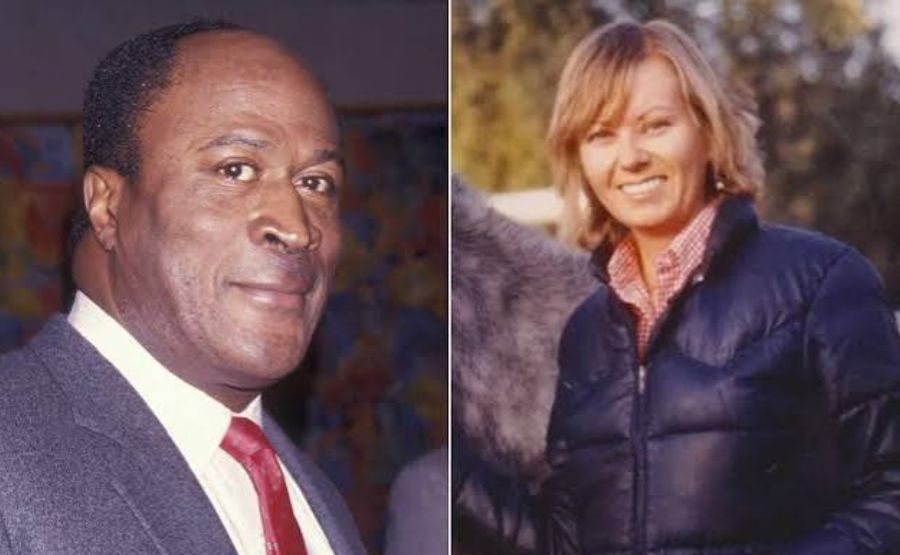
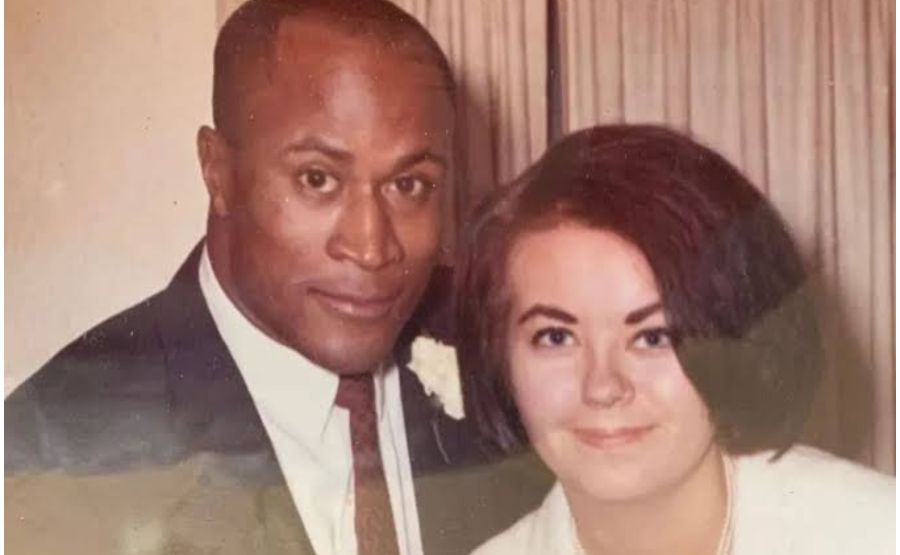
The wedding took place in the chapel at Colorado State University on December 27, 1965. By the genealogical record, it was a real event, documented in the Estherville Daily News on January 5, 1966. It was also, in the law of sixteen American states at that moment, a union that could not exist.
John Alan Amos Jr. was the son of a Newark mechanic and a housekeeper who had eventually put herself through school to become a nutritionist. He had Ghanaian ancestry on his father’s side. He had dreamed of professional football. When that door closed, he was looking for something else — not yet knowing it would be television, not yet knowing it would be fame.
Noel Mickelson was of Danish and Ashkenazi Jewish descent, from a small Iowa town. She and John were, as Shannon Amos would write decades later, different in nearly every measurable way. She came from European immigrant stock; he came from the Great Migration north. She came from lake country; he came from an industrial city. She was an artist; he was an athlete still searching for a stage.
Shannon later described their meeting as “love at first sight.” The cultural and historical forces moving around that love were anything but romantic. Malcolm X was assassinated just two months after their wedding, on February 21, 1965. Martin Luther King Jr. would be shot in April 1968. The Civil Rights Act of 1964 had only just banned racial discrimination in public accommodations. Loving v. Virginia — the Supreme Court ruling that struck down state bans on interracial marriage — would not arrive until 1967.
Noel and John married anyway. They did not wait for the law to catch up.
Social Work, Stand-Up, and the Slow Rise
After graduating, the couple did not move toward Hollywood. They moved toward New Jersey.
Both Noel and John worked as social workers in those early years, a choice that reflected the values each brought to the marriage. Noel’s artistic temperament had always coexisted with a practical social conscience. John, for his part, had not yet found his way to entertainment — he would first try professional football, then fail at it, then stumble into stand-up comedy on the Greenwich Village circuit.
Noel’s role in this transition deserves more credit than it typically receives. John Amos himself acknowledged it directly, telling The Hollywood Reporter in November 2023: “Being an artist herself, she understood my reluctance to accept the 9-to-5 world.” He was describing a specific quality — the ability of one artist to recognize and support the creative restlessness of another without demanding that it resolve into security. Noel gave John the space to fail, to pivot, to keep trying.
She moved with their daughter Shannon to Los Angeles as John began booking television commercials and then, in rapid succession, two roles that would define him: the weatherman Gordy Howard on The Mary Tyler Moore Show and, beginning in 1974, James Evans Sr. on Good Times. The family settled in Sylmar, in the San Fernando Valley, where Noel kept horses on their property.
The home in Sylmar was, by all accounts, a creative household. Shannon later recalled pool parties attended by Ben Vereen and Margaret Avery. K.C. Amos was born there in 1970, four years after Shannon. The children grew up surrounded by both their father’s emerging celebrity and their mother’s quieter, more private forms of artistry.
A Threat Becomes a Lesson
American racism in the 1960s and early 1970s was not abstract for an interracial family in the Valley. Shannon Amos has spoken publicly about one incident — a man leveling a gun at her father — that forced her parents to sit their young daughter down and explain something she had not previously needed to understand.
“As a child, I didn’t know my parents were different colors,” Shannon wrote in an Instagram post in June 2020. “I only saw them as my parents — the two people who loved me. All I knew was their love.” The gun incident changed that. Her parents had no choice, Shannon said, but to introduce her to “the existence of racism,” and her “innocent view of the world was forever changed.”
For Noel, navigating this was not incidental to the marriage — it was structural. She was a white Jewish woman whose husband faced the lethal hostility that Black men encountered as a matter of daily existence in America. Her children were growing up in the overlap between her world and his. She had to hold all of this while keeping horses, making furniture, sustaining a household, and supporting a husband whose career was becoming enormously public.
Shannon would later call her mother a “renaissance woman” who “didn’t let the roles of men or women define her.” That description is not hyperbole. It is a compressed account of a person managing multiple forms of complexity simultaneously, and doing so without drama or public acknowledgment.
Personal Life: The Divorce, the Breakdown, and the Second Chapter
The marriage ended in August 1975, the divorce finalized in Los Angeles County. No official reason has ever been given. Neither John nor Noel made public statements about its causes, and both maintained the privacy that had characterized their relationship from the beginning.
Shannon’s account of the period is the most honest available record. She described her mother as having gone through what she characterized as a nervous breakdown — sudden weight loss, emotional devastation, the visible marks of a person whose life had been reorganized against her will. Shannon was nine years old.
The divorce coincided almost exactly with one of the most turbulent moments of John’s career. A year later, his constant friction with the writers of Good Times over the direction of his character, James Evans, resulted in the character being killed off and John being fired from the show. The late 1970s were difficult for him. He married actress Lillian Lehman in 1978; that marriage lasted nineteen months.
Noel, by contrast, did not remarry immediately. She focused on her children, her horses, and her art. She eventually married a man who worked as a special-effects engineer at Disney — a person who, by every available account, shared her private temperament and her interest in craft. Together they lived on a ranch in California.
It was during this period that a hysterectomy resulted in catastrophic complications. Sources citing family accounts indicate Noel suffered severe consequences that included blindness and quadriplegia — medical outcomes that reduced the physical independence she had spent decades cultivating through equestrian competition and handcraft. The contrast is striking and painful: a woman known to her son as “the best endurance rider this side of the Mississippi,” reduced by surgical complications to a level of physical dependence entirely alien to everything she had been.
She endured this, too. Her children’s accounts suggest she remained a source of emotional sustenance to her family even through her own diminishment — a mother who, as Shannon later recalled, taught her daughter to call grief “grief-letting” and to “let your river of tears flow.”
The Art and the Animals
Noel Mickelson’s professional accomplishments outside her marriage deserve direct attention, because the record on them is frequently collapsed into a sentence or two.
She was a world-ranked endurance rider. Endurance riding is among the most physically demanding equestrian disciplines — races can span fifty to one hundred miles across challenging terrain, testing the horse-and-rider pair’s fitness, navigation, and mutual trust over hours. K.C. Amos’s description of his mother as the best endurance rider “this side of the Mississippi” is not mere filial pride. It describes someone who competed seriously and attained recognized standing in the sport during the 1970s and 1980s. Her horse, Ondelay, was remembered within the family as a central figure in that chapter of her life.
As an artist, Noel worked across multiple media: painting, woodworking, furniture making, textile crafts. She did not exhibit publicly in ways that generated an institutional record. But Shannon’s description of her as a woman who “could do anything she set her mind to” — who broke gender expectations through the practical exercise of skills coded male — points toward an artistic practice that was deeply integrated with how she moved through the physical world.
Her environmental commitments extended this integration. She was an advocate for sustainable land use and natural resource preservation — values that were, in the 1970s, still forming into what would eventually be called environmentalism.
Legacy and Lasting Influence
The case for Noel J. Mickelson’s historical significance does not rest on celebrity or institutional achievement. It rests on something quieter and more durable.
She married across the color line in 1965, two years before the legal framework that would have protected her right to do so. The Loving v. Virginia decision of 1967 struck down state bans on interracial marriage, but the social hostility that had preceded it did not dissolve with the ruling. Noel and John raised two children inside that hostility — children who grew up, by Shannon’s own account, not initially aware that their family was considered aberrant.
That early innocence was itself a form of gift. Shannon and K.C. both built careers in the entertainment industry, in producing, directing, and writing. K.C. directed a documentary about his father titled America’s Dad, still in production at the time of John’s death in August 2024. Shannon became a producer and writer for BET, MTV, and other media institutions. Both cite their mother as the source of their creative foundation.
John Amos himself, in his own words, attributed the earliest and most important chapter of his career to Noel’s understanding and support. Without her willingness to relocate, to share the precarity of a household dependent on a performer’s uncertain income, his trajectory would have been different.
Shannon has continued to honor her mother publicly. In February 2024, she quoted Noel’s phrase for emotional release — “grief-letting,” the instruction to let your tears flow — as a teaching that still guides her. She traveled the world carrying Noel’s ashes after her mother’s death in December 2016, beginning in January 2017, because Noel had expressed, in her final moments, only one regret: that she had not seen more of it.
That wish — travel, experience, the world beyond the Midwest and California and the ranch — is a small window into who Noel Mickelson really was. Not a woman defined by her marriage, though her marriage was significant. Not a woman defined by her illness, though her illness was severe. A woman who had spent decades doing things — making things, riding horses, raising children, enduring complications — who arrived at the end of her life and wished only that she had done more of the world.
Final Words
Noel Jean Mickelson died in December 2016. She was seventy-three years old. Her death was private, her cause undisclosed, her passing known primarily through her children’s social media posts and a WikiTree genealogical record.
That privacy is, in retrospect, entirely characteristic. She was not a public figure. She did not seek to become one. She lived beside fame without entering it, supported a career she had helped make possible, raised children who carry her values forward, and made things with her hands until her hands no longer worked.
The interracial marriage she entered in 1965 was not simply a romantic fact — it was a civil act. She and John Amos were not making a statement, exactly; they were following a feeling. But the statement was made whether they intended it or not, in the Estherville Daily News wedding announcement of January 5, 1966, in the chapel at Colorado State University where the ceremony was held, in every day of the ten years they built together.
The world that surrounded that marriage — the assassinations, the armed racists, the slow extension of legal protection — did not ultimately break them. The marriage ended for reasons neither made public, as marriages do. What remained was two children who credit their mother with giving them everything essential, and a woman who spent her last energy not on regret but on the simple wish to see more of the world she had lived in with such determined, complicated, patient grace.
Shannon Amos flew with her mother’s ashes to places Noel had never been. That is as precise a statement of love as any record contains.
FAQs
1. When and where was Noel J. Mickelson born?
Noel Jean Mickelson was born on August 22, 1943, in Jackson County, Minnesota, to Wilbur B. Mickelson and Dorothy J. Tims. The family later moved to Estherville, Iowa, where she spent much of her youth.
2. What was Noel Mickelson’s heritage?
Her daughter Shannon has described her as being of Danish and Ashkenazi Jewish descent, reflecting European immigrant roots distinct from the African American background of her husband, John Amos.
3. Where did Noel and John Amos meet?
They met as students at Colorado State University in Fort Collins, Colorado. Noel was studying fine arts; John was a student-athlete playing football and studying sociology.
4. When did they marry, and why was the marriage historically significant?
They married on December 27, 1965, at the Colorado State University chapel. At the time, interracial marriage was illegal in approximately sixteen U.S. states. The Supreme Court would not strike down those laws until Loving v. Virginia in 1967, making their union legally precarious for its first two years.
5. What did Noel Mickelson do professionally?
She was a fine arts graduate, a world-ranked endurance equestrian, a painter and furniture maker, a craftsperson who worked across multiple media, and in her early post-college years, a social worker alongside John Amos.
6. How did Noel support John Amos’s career?
She relocated with him from New Jersey to Los Angeles to support his entertainment pursuits. John later credited her directly, noting that her own artistic sensibility allowed her to understand his unwillingness to settle for a conventional career.
7. Who are Noel’s children?
Shannon Amos, born in 1966, who became a writer and producer, working for BET and MTV among others. Kelly Christopher “K.C.” Amos, born in 1970, who became a director, producer, and video editor.
8. Why did Shannon say she was “born a year before my parents would be recognized as a legal couple in 16 states”?
Shannon was born in 1966, one year before Loving v. Virginia (1967) invalidated state bans on interracial marriage. Her parents were legally married in states where such marriages were permitted, but not in the sixteen states that still prohibited them until the 1967 ruling.
9. When did Noel and John Amos divorce?
Their divorce was finalized in August 1975 in Los Angeles, after ten years of marriage. Neither party publicly disclosed the reasons.
10. What happened to Noel after the divorce?
She continued raising her children, pursued her artistic and equestrian work, and eventually married a Disney special-effects engineer. They lived together on a California ranch.
11. What health challenges did Noel face later in life?
A hysterectomy resulted in severe complications. Family accounts, cited through Shannon and K.C.’s public statements, indicate she suffered blindness and quadriplegia as consequences — a particularly harsh outcome for a woman whose life had been defined by physical skill and independence.
12. What was Noel’s family nickname?
“Noni.” Both Shannon and K.C. use this name when referring to her in social media posts and public accounts.
13. When and how did Noel Mickelson die?
She died in December 2016, surrounded by her family. The cause of death was not publicly disclosed. She was seventy-three years old.
14. What was Noel’s final wish?
In her last moments, she told Shannon she wished she had traveled more to see the world. Shannon honored this by taking her mother’s ashes on a global journey beginning in January 2017.
15. What is Noel Mickelson’s broader historical legacy?
She is a figure who quietly participated in one of the more consequential social experiments of the American 1960s — interracial marriage during the height of the civil rights struggle — while building an independent identity as an artist and athlete. Through her children, her values and creative influence persist in the entertainment industry. John Amos himself, across decades, named her as essential to his early success.
Every story matters—discover them all with Daily Narrative.