Kate Connelly: The Host Who Helped Build Food Television — and Then Walked Away From It
Kate Connelly is significant to the history of American food media not because she rose to fame but rather because she was there and employed at the exact time the Food Network launched inventing what food television could be — and because the daughter she raised during and after that era has now become one of the clearest arguments that the values of serious journalism can be transmitted across generations.
Quick Facts
| Full Name | Kate Connelly |
| Date of Birth | c. 1964–1966 (sources conflict; Minneapolis, Minnesota, USA) |
| Nationality | American |
| Hometown | Minneapolis, Minnesota |
| Education | Journalism degree (St. Michael’s College cited by multiple sources; Massachusetts College of Art and Design cited by others — exact institution unverified) |
| Primary Professions | Television host; broadcast journalist; culinary media presenter; restaurateur |
| Signature Show | Robin Leach Talking Food (Food Network, early-to-mid 1990s) |
| Network | Television Food Network (TVFN, later Food Network) |
| Marriage | Robert William “Bobby” Flay — married October 1, 1995; separated 1998; divorced |
| Ex-Husband’s Previous Marriage | Bobby Flay was previously married to chef Debra Ponzek (May 11, 1991 – 1993) |
| Children | Jonathan (son from prior relationship; b. c. 1986–88; works in radio production); Sophie Flay (b. April 16, 1996; with Bobby Flay; ABC News correspondent and co-anchor since October 2025) |
| Wedding Reception Venue | Bolo Bar & Restaurant, Manhattan, New York (Bobby Flay’s restaurant) |
| Post-divorce | Restaurant co-ownership with Bobby Flay reported; private life maintained |
| Estimated Net Worth | $2.3–2.5 million (multiple sources; unverified) |
| Current Status | Private; believed to reside in New York; no active public media presence |
Minneapolis to Manhattan: The Formation of a Food Television Voice
The Food Network launched on November 23, 1993, and the world it entered was almost entirely unprepared for what food television could become.
Kate Connelly arrived at that network from the upper Midwest, carrying a journalism degree and a set of skills — camera presence, conversational fluency, genuine enthusiasm for cooking — that the nascent channel needed far more than it needed credentials. She was born in Minneapolis, Minnesota, sometime in the mid-1960s, the daughter of a father whose profession touched journalism and a mother whose influence in the kitchen shaped her earliest understanding of food as culture.
The exact dates and institutions in her biography are disputed across sources in ways that reflect the thin documentary record that exists for early Food Network talent. Her birth year appears as 1964, 1966, and 1970 across different outlets. Her college is cited as St. Michael’s College in some accounts and Massachusetts College of Art and Design in others. What all sources agree on is the substance: she studied journalism, she developed a passion for cooking, and she moved to New York to build a career in broadcast media. The details around those facts remain private, in a pattern that would characterize her entire adult life.
What is verifiable is the outcome: she became the co-host of Robin Leach Talking Food, one of the early Food Network’s distinctive programs, at a moment when the channel was still determining what it was for.
Robin Leach Talking Food: Early Food Television’s Most Human Hour
The Television Food Network that launched in 1993 was not the polished, competition-show-driven cable empire it later became. It was an experiment — a channel funded on modest budgets, staffed with personalities who were chosen more for warmth and authenticity than for established celebrity, and aimed at an audience that was not yet sure it wanted to watch people cook on television for hours at a time.
Robin Leach Talking Food occupied a peculiar and genuinely interesting niche within that experiment. Robin Leach, already famous for the aspirational excess of Lifestyles of the Rich and Famous, brought an incongruous but effective energy to the food world — he understood that food was about desire, pleasure, and the gap between everyday life and something better. Kate Connelly, as co-host, provided the grounding. She cooked on camera. She conducted interviews with chefs, sommeliers, restaurateurs, and occasionally people with no culinary credentials whatsoever beyond enthusiasm.
The show’s texture, as described across multiple contemporaneous and retrospective accounts, was deliberately imperfect. Champagne corks flew. Blenders ran without lids. Kitchen mishaps were not edited out — they were the material. The implicit argument was that cooking was approachable, that failure was funny rather than shameful, and that a person could talk to a Michelin-starred sommelier and a woman who collected refrigerator magnets with the same genuine curiosity and find both equally interesting.
This was, in 1993 and 1994, a genuinely new idea for American television. The cooking show tradition before the Food Network was dominated by authority figures — Julia Child, Jacques Pépin — whose mastery was the point. Robin Leach Talking Food suggested that the conversation around food could be as important as the food itself, and that the host’s job was to be curious rather than expert.
Kate Connelly was built for that format. Her journalism training gave her the conversational architecture. Her Midwestern background gave her the approachability. Her genuine interest in cooking gave her credibility in the kitchen even when the blender lid went flying.
January 1994: The Guest Who Changed Everything
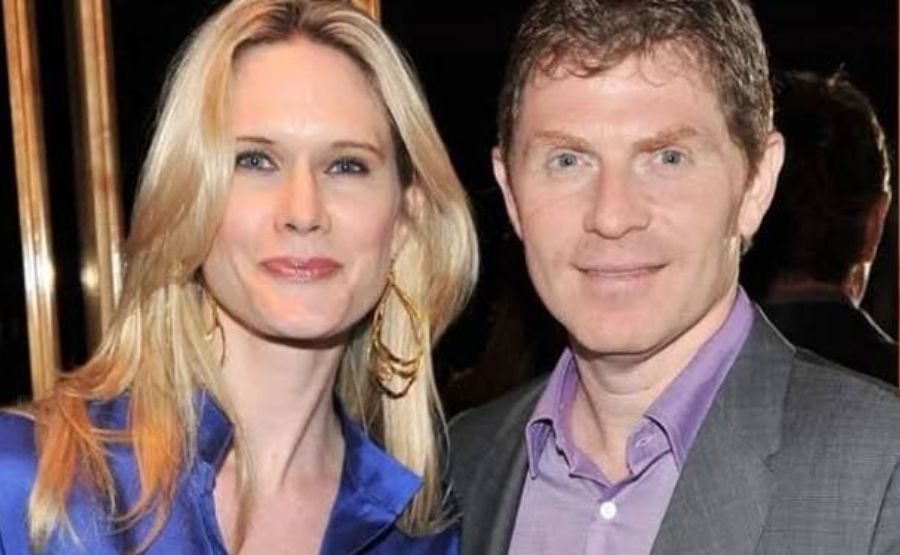
In January 1994, Bobby Flay walked onto the set of Robin Leach Talking Food as a featured guest.
He was, at that moment, exactly the kind of New York culinary figure the show was designed to showcase. He had opened Mesa Grill on January 15, 1991, as executive chef and partner. He had opened Bolo Bar & Restaurant in the Flatiron District in November 1993, a few weeks prior to his Talking Food visit.He had been teaching at the French Culinary Institute. He had appeared on a handful of television cooking programs. He had recently divorced chef Debra Ponzek. He was living in a Manhattan apartment furnished in white — white carpet, white furniture, modern art — and he was, by multiple accounts, in the early and productive stage of building an empire.
He appeared on the show. He and Kate were instantly drawn to each other. The professional context — two people who cared about food and television, meeting in the specific environment where those interests overlapped — accelerated the personal connection. Flay invited her to dinner at the Monkey Bar shortly after filming. They spent four and a half hours on their first date.
The speed of what followed was characteristic of both their temperaments in that period. They dated for roughly a year before marrying on October 1, 1995. The wedding reception was held at Bolo, Bobby’s restaurant in the Flatiron District — a venue choice that embedded their personal milestone directly into the professional world they both inhabited. Former teammate JuJu Smith-Schuster and others congratulated the couple, reflecting how thoroughly the culinary world treated their union as an institutional event.
Sophie, 1996: The Daughter Who Inherited Both Worlds
Sophie Flay was born on April 16, 1996, in New York City, into a household where food and media were not professional categories but the actual texture of daily life.
Her parents were, at the moment of her birth, two of the more recognizable figures in the rapidly expanding food television world. Bobby was building his restaurant portfolio while developing his Food Network presence. Kate had established herself as a recognizable host in the early network’s lineup. Their daughter arrived into an apartment in Manhattan where the kitchen was not simply a room but a professional arena.
Sophie would later say, in interviews, that she grew up surrounded by some of the best chefs and restaurants in the world — a statement that is factually precise and experientially understated. She grew up eating at tables where the food was cooked by people who had spent their careers thinking about nothing else. She grew up watching her father navigate the intersection of culinary craft and television performance. She grew up watching her mother demonstrate that a journalist could make food her subject and be taken seriously.
Sophie was two years old when her parents separated in 1998. She was raised primarily in Fairfield, Connecticut, where she attended Fairfield Warde High School. She eventually enrolled at the University of Southern California, majoring in broadcast and digital journalism at the USC Annenberg School. She interned with NBC Sports at the 2016 Summer Olympics in Rio de Janeiro and the 2018 Winter Olympics in Pyeongchang. She was named to TV Week’s 40 Under 40 in 2024. In October 2025, she joined ABC News as a correspondent and overnight co-anchor of World News Now and Good Morning America First Look, based in New York.
The career Sophie built is verifiably her own — built through internships, local reporting at KABC-TV’s ABC7 in Los Angeles, six years of community and general assignment reporting, and the gradual accumulation of skills that national network anchors develop across a decade of work. But the raw materials — the journalism instinct, the camera comfort, the genuine interest in telling stories accurately — trace directly to both parents. Bobby Flay gave her access to the food world and the entertainment infrastructure. Kate Connelly gave her the journalist’s frame through which to view everything else.
The Divorce and the Decision Not to Return
The marriage ended in 1998, after approximately three years. Neither Bobby Flay nor Kate Connelly has offered a detailed public account of what ended it. The Bobby Flay Wikipedia entry states simply that “Flay and Connelly separated in 1998 and later divorced.” Multiple sources attribute the separation to the compounding pressures of two very public, very demanding careers — a diagnosis that is probably accurate as far as it goes and certainly incomplete.
What happened next is where Kate Connelly’s story diverges most sharply from the template of celebrity divorce.
She did not return to television. When Robin Leach Talking Food ended, and when conversations about a follow-up program were apparently ongoing, she chose not to pursue them. Multiple sources note this decision without fully explaining it, attributing it variously to a preference for privacy, a desire to focus on her children, or simply a temperamental distance from the competitive hunger that sustains long careers in broadcast media.
The sources here are thin, and honesty requires acknowledging it: very little about Kate Connelly’s post-divorce life is verifiably documented. She is reported to have maintained co-ownership interests in some of Bobby Flay’s restaurant ventures. She is believed to reside in New York. Her son Jonathan, from a relationship prior to Bobby Flay, worked in radio production — listed in one account as a network producer on The Anna and Raven Show and as an on-air personality. Her daughter Sophie maintains a close relationship with her that is periodically glimpsed in Sophie’s social media posts.
She has given no interviews since leaving television. She has maintained no public social media presence of significance. She has not written a memoir. She has not leveraged her proximity to one of Food Network’s most successful careers into a platform of her own.
This consistent refusal to engage with public life is, at this point, a three-decade pattern. It deserves respect as a genuine preference rather than a failure.
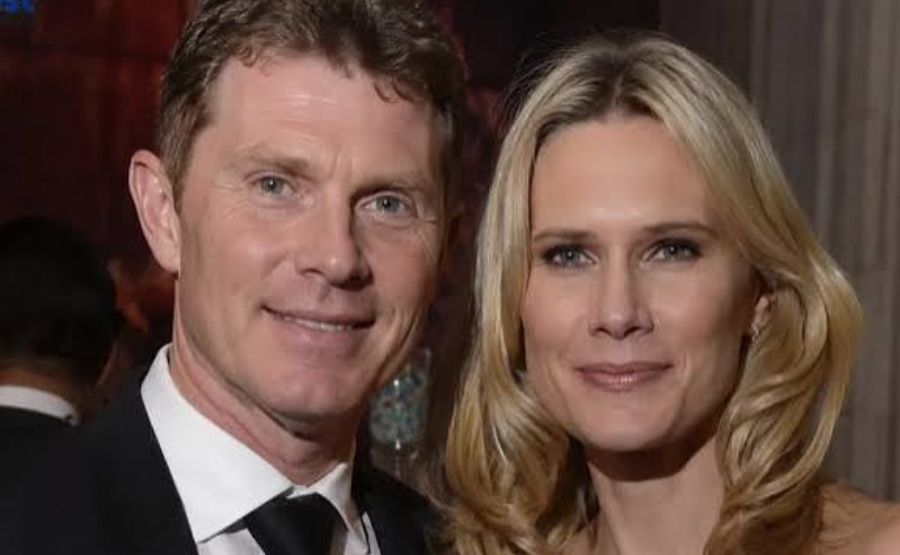
Personal Life: Two Children, Two Relationships, One Coherent Commitment
The full picture of Kate Connelly’s family life is more complex than the celebrity gossip ecosystem typically acknowledges.
Before Bobby Flay, she had a son named Jonathan. His birth year places him in the mid-to-late 1980s based on the ages cited in available sources. He appears to have been a young child, possibly a toddler, when Kate moved to New York and began her television career. Multiple sources describe Kate during the period when she first met Bobby Flay as a single mother managing both her career and her son’s upbringing — a circumstance that adds dimension to the timeline of her early Food Network years.
Jonathan has remained almost entirely out of the public record. The single verified detail is his professional work in radio production, cited through his Instagram bio by the Skabash biographical profile. He is, in his own way, as private as his mother.
Sophie Flay is the more public of Kate’s two children, and Sophie’s career arc illuminates something important about Kate’s choices. Sophie has credited both parents with shaping her. Bobby Flay has described his pride in her career in unmistakably genuine terms. But the journalism that Sophie practices — the insistence on accuracy, the interest in community storytelling, the instinct to report rather than perform — looks like it came from the parent who studied journalism and then made a television show out of talking to people seriously about what they ate.
Kate and Bobby Flay have maintained, by all available accounts, a functional and genuinely cooperative co-parenting relationship across the nearly three decades since their separation. Sophie’s own public statements about her upbringing describe a childhood marked by support from both parents. That Sophie was raised primarily in Connecticut — away from the Manhattan restaurant world her father inhabited — suggests a deliberate choice about the kind of childhood Kate wanted to provide.
Legacy and Durable Impact: The Trailblazer Who Departed Before the Genre Reached Its Pinnacle
Kate Connelly worked at Food Network during the channel’s formative period, when its conventions and voice were still being invented.
The Food Network launched in November 1993 with a modest subscriber base and an unclear identity. By the early 2000s, it had become a cultural phenomenon, producing stars — Emeril Lagasse, Bobby Flay, Ina Garten, Rachael Ray, Guy Fieri — whose faces were recognizable to millions of Americans who had never eaten in a serious restaurant. The channel had discovered that cooking shows were entertainment, that competition formats were addictive, and that personality mattered as much as technique.
Kate Connelly was part of the generation that figured out the early version of all of this. Robin Leach Talking Food helped establish the principle that a food show could be conversational rather than instructional, that it could be about people as much as recipes, and that a host’s genuine enthusiasm was more valuable than culinary mastery. These principles were absorbed into the Food Network’s DNA. The shows that came after — the interview-format programs, the personality-driven travel and food hybrids, the chatty kitchen companions — all owe something to the early experiments in which Kate Connelly participated.
She did not stay to collect that credit. She left before the genre reached its commercial peak, and she has not returned to claim retrospective recognition. Her name appears in the historical record primarily through her connection to Bobby Flay and through the career of the daughter she raised. Both are real legacies, but neither fully captures what she actually did.
The case for her significance in food television history is straightforward: she was there at the beginning, she helped shape the format’s early voice, and she made choices — particularly around the texture and tone of culinary conversation on screen — that proved prescient. The Food Network became, eventually, exactly what Robin Leach Talking Food was gesturing toward: a channel where personality, curiosity, and accessibility were as important as culinary expertise.
She helped invent that. Then she walked away.
Final Words
Kate Connelly’s biography is, in one reading, a story of withdrawal — a career that peaked early, a marriage that ended, a deliberate retreat into privacy that has lasted nearly thirty years. That reading is not wrong, but it misses the generative quality of the choices she made.
She raised two children who became media professionals. Jonathan works in radio production. Sophie co-anchors Good Morning America First Look and World News Now for ABC News, having built her career through six years of local reporting that taught her the discipline that network television demands. Sophie has described her upbringing as loving and full of support from both parents. The co-parenting arrangement between Kate and Bobby Flay has functioned, by all available evidence, with genuine goodwill across three decades.
She worked on a television channel at its inception and contributed to the development of a format — conversational food media — that became one of American cable television’s most successful genres. She did this without formal culinary training, relying instead on journalism skills and genuine curiosity. She demonstrated that the host of a food show did not need to be a chef; they needed to be interested, articulate, and comfortable with the gap between what they knew and what their guests could teach them.
She then chose to be private, and she has executed that choice with remarkable consistency. In 2026, more than three decades after her Food Network years, she maintains no significant public presence. The internet’s appetite for biographical information has generated numerous articles about her, most of them recycling the same thin set of verified facts through increasingly elaborate speculation. The actual Kate Connelly remains largely opaque.
What is clear is this: she built something real, in food television and in family life, and she did it on her own terms at every stage. The daughter she raised is now reporting the news to millions of Americans. The format she helped develop is now a global industry. And Kate Connelly herself has maintained the privacy she appears to have wanted, which is, by any reasonable measure, exactly the kind of success most people spend their lives trying to achieve.
FAQs
1. Who is Kate Connelly?
Kate Connelly is a former American television host, broadcast journalist, and culinary media personality who co-hosted Robin Leach Talking Food on the Food Network in the early-to-mid 1990s. She is also known as the former wife of celebrity chef Bobby Flay and the mother of ABC News correspondent Sophie Flay.
2. Where was Kate Connelly born?
She was born in Minneapolis, Minnesota. Her exact birth year is disputed across sources, with 1964, 1966, and 1970 all cited in different biographical accounts. January 21 is the most consistently cited birth date.
3. Where did Kate Connelly attend college?
Sources conflict on this point. St. Michael’s College is cited in multiple accounts; Massachusetts College of Art and Design appears in others. All sources agree she studied journalism and used that training as the foundation of her television career.
4. What was Robin Leach Talking Food?
It was a Food Network program co-hosted by Kate Connelly and produced in association with Robin Leach of Lifestyles of the Rich and Famous fame. The show featured interviews with chefs, sommeliers, restaurateurs, and ordinary food enthusiasts, combined with live cooking segments. It was notable for its conversational, humor-forward approach to culinary content.
5. How did Kate Connelly and Bobby Flay meet?
They met in January 1994 when Bobby Flay appeared as a guest on Robin Leach Talking Food. Multiple sources describe an immediate mutual attraction. Flay invited Connelly to dinner at the Monkey Bar shortly after, and their first date reportedly lasted four and a half hours.
6. When did Kate Connelly and Bobby Flay get married?
They married on October 1, 1995. Their wedding reception was held at Bolo Bar & Restaurant, Bobby Flay’s restaurant in the Flatiron District of Manhattan.
7. Was Bobby Flay married before Kate Connelly?
Yes. Flay was married to chef Debra Ponzek from May 11, 1991, until their divorce in 1993. Kate Connelly was his second wife.
8. Does Kate Connelly have children other than Sophie Flay?
Yes. She has a son named Jonathan from a relationship prior to Bobby Flay. Jonathan’s exact birth year is not publicly confirmed, but he was born in the mid-to-late 1980s. He works as a radio producer and on-air personality, most recently associated with The Anna and Raven Show.
9. When did Sophie Flay promote to ABC News?
Sophie Flay joined ABC News in October 2025 as a correspondent and overnight co-anchor of World News Now and Good Morning America First Look, based in New York City. Before that, she spent six years at KABC-TV (ABC7) in Los Angeles.
10. Did Kate Connelly continue working in television after her divorce?
No. All available sources indicate she chose not to return to television after the end of both her marriage and her primary Food Network program. She has maintained a private life since the late 1990s.
11. Is Kate Connelly still co-owner of any Bobby Flay restaurants?
Multiple sources report that she retained co-ownership interests in some of Flay’s restaurant ventures as part of their divorce settlement, but the current status of any such arrangements has not been publicly disclosed or confirmed.
12. Where does Kate Connelly live now?
She is believed to reside in New York, though some sources suggest she may split time between the East Coast and the West Coast. No verified address or confirmed location is available.
13. What is Kate Connelly’s relationship with Sophie Flay today?
Sophie Flay has described both her parents as supportive, and Kate appears periodically in family photographs and events that Sophie shares on social media. Their relationship is characterized by multiple sources as close and warm. Sophie chose to pursue broadcast journalism — the same field in which her mother trained — which many observers view as a significant indicator of Kate’s continued influence.
14. Has Kate Connelly appeared in any other media since leaving Food Network?
Sources reference a small acting role in the 2018 film Blaze, in which she reportedly appeared alongside Chris Hemsworth. This is cited consistently but without confirmation from major film databases. It represents her only documented media appearance since leaving television.
15. What is Kate Connelly’s estimated net worth?
Multiple sources estimate her net worth at approximately $2.3 to $2.5 million, attributed to her television career earnings, reported restaurant co-ownership proceeds from her marriage settlement, and other private investments. These figures are unverified and should be treated as informed estimates rather than confirmed financial data.
Every story matters—discover them all with Daily Narrative.