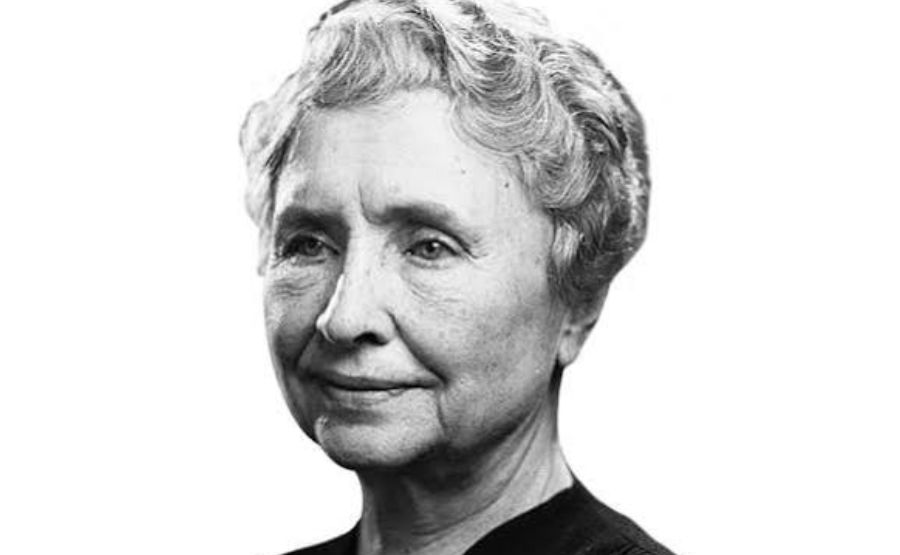
Helen Keller: The Radical Mind America Chose to Forget
Helen Keller remains urgently relevant today not because she overcame blindness and deafness, but because the way the world chose to tell her story — stripping it of its politics, its desires, and its contradictions — reveals precisely the kind of silencing she spent her entire adult life fighting against.
Quick Facts
| Category | Details |
| Full name | Helen Adams Keller |
| Born | June 27, 1880, Tuscumbia, Alabama, United States |
| Died | June 1, 1968, Westport, Connecticut, United States (age 87) |
| Nationality | American |
| Primary roles | Author, lecturer, disability rights advocate, socialist political activist, suffragist, co-founder of the American Civil Liberties Union (ACLU) |
| Education | Radcliffe College (Bachelor of Arts, cum laude, 1904) — first deafblind person to earn a college degree |
| Key relationships | Anne Sullivan Macy (teacher, companion, 49 years); Polly Thomson (secretary and companion after Sullivan); Peter Fagan (journalist, thwarted love interest, 1916); John Macy (Sullivan’s husband, literary collaborator) |
| Political affiliations | Socialist Party of America (joined 1909); Industrial Workers of the World (IWW); founding member, American Civil Liberties Union (1920) |
| Major publications | The Story of My Life (1903); The World I Live In (1908); Out of the Dark (1913); My Religion (1927); Midstream: My Later Life (1929); Teacher: Anne Sullivan Macy (1955) |
| Key honors | Presidential Medal of Freedom (1964, awarded by President Lyndon B. Johnson); Academy Award–winning documentary Helen Keller in Her Story (1955); honorary degree from Harvard University |
| Notable milestones | FBI watchlist by 1953; international advocacy tours across Asia, Europe, and the Middle East; Lions Clubs International address (1925); her archives partially destroyed in the September 11, 2001 attacks |
Born Into Light, Plunged Into Dark
Helen Adams Keller entered the world on June 27, 1880, in the town of Tuscumbia, in the Tennessee Valley of northern Alabama. Her father, Arthur Henley Keller, was a former officer in the Confederate Army who edited a local newspaper. Her mother, Catherine “Kate” Adams Keller, came from a distinguished Boston family with connections to some of New England’s intellectual elite.
The Kellers were comfortable by Southern standards of the era, occupying a homestead called Ivy Green that Helen’s paternal grandfather had constructed. Enslaved and later hired Black servants worked in the household. Keller arrived into material privilege, but also into a region still reorienting itself after the Civil War’s devastation.
When Keller was approximately nineteen months old — the historical record places this in early 1882 — she contracted a severe illness, most likely scarlet fever or meningitis, that within days left her completely without sight and hearing. A child who had already begun to form words lost access to sound, to light, and to the shared language through which human beings locate themselves in relation to one another.
She was not, contrary to what later mythology suggested, entirely without means of communication. By age six, she had invented more than sixty home signs to convey basic needs and emotions to her family. But the deeper world of abstraction — of ideas, of literature, of argument — remained sealed from her.
Anne Sullivan and the Water That Changed Everything
In the autumn of 1886, Kate Keller traveled north with her daughter to meet Alexander Graham Bell, who had devoted considerable energy to educating deaf individuals. Bell directed the Kellers toward Michael Anagnos, the director of the Perkins Institution for the Blind in Boston. Anagnos recommended his most outstanding recent graduate: twenty-year-old Anne Mansfield Sullivan.
Sullivan herself had experienced a harsh and formative life. Her own vision was severely impaired by a childhood trachoma infection, and she had spent years in the notorious Tewksbury Almshouse after her mother’s death left her effectively orphaned. She understood deprivation from the inside.
Sullivan arrived at Ivy Green on March 3, 1887. Keller was six years old and combative. She fought Sullivan’s early instruction with biting and hair-pulling. The resistance lasted weeks. Then, on April 5, 1887, Sullivan led Keller to the outdoor water pump and spelled the letters W-A-T-E-R into the wet palm of her hand as water flowed over their hands simultaneously.
Something unlocked. Keller later described the sensation as a sudden, rushing comprehension that everything in the world had a name — and that those names could be placed inside her hand. She ran from object to object demanding their names. In the space of an afternoon, the mechanism of language opened to her.
The moment has since been so thoroughly dramatized — in William Gibson’s 1959 play The Miracle Worker, in the 1962 film, in countless retellings — that it risks collapsing into legend. What the legend obscures is the decades of rigorous, often exhausting work that followed: Sullivan spelling entire books and lectures into Keller’s hand, reading for hours until her own failing eyes gave out, and constructing a pedagogical relationship that had no precedent and few guides.
Radcliffe and the Making of an Intellectual
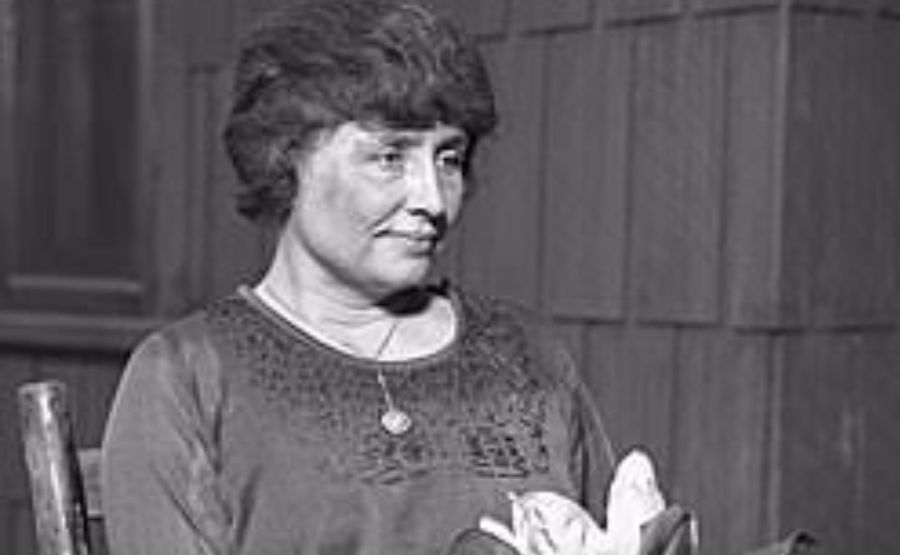
Keller’s trajectory toward formal higher education was itself an act of sustained will. She attended the Cambridge School for Young Ladies in Massachusetts and the Horace Mann School for the Deaf. She passed Harvard’s Radcliffe College entrance examinations in 1899 and enrolled the following year.
The experience at Radcliffe was not uniformly welcoming. Many of her textbooks had not been translated into Braille. Sullivan spent hours manually spelling lectures and readings into Keller’s hand. Keller sometimes concealed how much she strained Sullivan’s vision simply to avoid placing additional burden on her teacher.
In 1903, while still a student, Keller published The Story of My Life, co-written with assistance from Sullivan and Sullivan’s future husband, John Macy, a literary critic. The memoir remains in print today and has been translated into dozens of languages.
In June 1904, Keller graduated from Radcliffe cum laude, becoming the first deafblind person in history to earn a Bachelor of Arts degree. She was twenty-four years old. She was also, by then, internationally famous — a celebrity whose face appeared on the covers of magazines and who had corresponded with Mark Twain, who called her one of the two most interesting people of the nineteenth century (the other being Napoleon).
The Radical Turn: Socialism, the IWW, and the Fight for Workers
The transformation of Helen Keller from celebrated prodigy into committed political radical took roughly a decade and was driven by intellectual discovery rather than personal trauma. After graduation, Keller began independently studying the conditions that produced blindness across the American population.
What she found radicalized her. She discovered that blindness concentrated disproportionately among industrial workers exposed to dangerous chemicals and machinery, and among poor people who lacked adequate medical care. She connected the geography of disability to the geography of poverty and concluded that they shared the same root: an economic system that extracted labor from human bodies without adequate regard for those bodies’ welfare.
She joined the Socialist Party of Massachusetts in 1909, the same year she published The World I Live In. By 1912, she had become one of the most visible socialist voices in the country. Her 1913 collection Out of the Dark laid out her political vision with clarity and force. She joined the Industrial Workers of the World — the IWW, or “Wobblies” — embracing their vision of industrial unionism as a more honest vehicle for structural change than the socialist mainstream.
The reaction from her previous admirers was swift and revealing. Newspapers that had celebrated her as an inspirational miracle turned on her with remarkable speed. The Detroit Free Press and others argued that her political positions reflected the inherent limitations of her disability — that she was simply too cognitively impaired by her deafblindness to reason correctly about economics. The condescension was nearly total, and entirely transparent in its motivation.
Keller addressed this directly and with precision. She noted, in multiple letters and speeches, that the same newspaper editors who had praised her insight and intelligence when she quoted poetry became suddenly concerned about her mental capacity the moment she quoted Marx.
A Political Life Without a Personal One: Peter Fagan and the Thwarted Romance
In 1916, Helen Keller was thirty-five years old, world-famous, and had never been alone with a man. Her family had carefully managed, and at times forcibly prevented, any romantic possibility from developing. When a handsome student was assigned to proctor her Radcliffe examinations, her mother had him removed.
That year, Sullivan fell gravely ill — she was diagnosed with tuberculosis and required extended rest at a sanitarium in Lake Placid. Sullivan’s estranged husband, John Macy, arranged for a young journalist from the Boston Herald named Peter Fagan, twenty-nine years old and a fellow socialist, to serve as Keller’s temporary secretary.
Fagan learned to communicate by fingerspelling into Keller’s hand. The two fell in love. They obtained a marriage license in Boston, intending to wed quietly. A reporter discovered the license and published the story. The immediate family response was triggered by the public disclosure.
Keller’s mother traveled to confront the situation. Sullivan, once she learned of the relationship, did not support it. Keller was dispatched to her family in Montgomery, Alabama, where her brother-in-law reportedly appeared with a firearm on one occasion when Fagan tried to reach her. The couple planned twice to elope; both times the plan collapsed. Fagan ultimately did not appear at their final arranged meeting point. He vanished from her life.
Keller wrote about the episode in her 1929 memoir Midstream, calling it her “little isle of joy” and expressing a mixture of gratitude and grief. The letters between them were later destroyed in a house fire, eliminating primary evidence of what the relationship contained. What survives in Keller’s own words is an account of a woman who understood, with deep clarity, what her family and her world thought she was entitled to — and what they thought she was not.
She never married. She never had children. She lived, for the rest of her adult life, in the domestic arrangements constructed around her professional needs rather than her personal desires.
The Sullivan Partnership: Collaboration, Dependency, and Its Costs
The forty-nine-year relationship between Helen Keller and Anne Sullivan was one of the most documented and most misunderstood partnerships in American intellectual history. It was frequently framed, in popular culture, as a story of rescue — a helpless child illuminated by a heroic teacher. The reality was considerably more reciprocal and considerably more complicated.
Sullivan needed Keller as much as Keller needed Sullivan. Teaching Keller gave Sullivan’s life a structure, purpose, and economic foundation it would otherwise have lacked. Sullivan’s childhood poverty and institutional upbringing left her with a deep-seated anxiety about destitution; Keller’s international fame and lecture circuit provided material security for both of them.
At the same time, the dependency that the relationship imposed on Keller was profound. Sullivan spelled every lecture, every conversation, every book into Keller’s hand. Every social interaction required Sullivan as intermediary. Critics noted, not entirely without foundation, that Sullivan’s interpretation of Keller was necessarily filtered through Sullivan’s own perspective and limitations.
This question — how much of the public “Helen Keller” was actually Helen Keller — surfaced during Keller’s lifetime and has resurfaced in the internet era with particular sharpness. A viral TikTok in 2020 accused Keller of outright fraud, arguing that no deafblind person could have done what she claimed. The accusation collapsed under scrutiny: Keller’s methods were well-documented, independently verified, and subject to extensive contemporary observation. But the accusation revealed a cultural anxiety about the limits of achievement under disability that Keller herself had spent decades confronting.
Sullivan married John Macy in 1905 and continued living with Keller after the marriage dissolved. When Sullivan’s health deteriorated in her final years and she went fully blind, Keller reversed the dynamic — guiding Sullivan, writing her letters, and providing the emotional constancy that Sullivan had long provided her. Sullivan died in October 1936. Polly Thomson, a Scottish woman who had joined the household in 1914, became Keller’s companion and secretary for the final decades of her active life.
The Complications History Prefers to Omit
Helen Keller’s political record was not uniformly progressive by modern standards. In 1915, she wrote in support of the practice of withholding life-saving medical care from newborn infants with severe physical or cognitive impairments — a position rooted in the eugenics movement that had captured a broad cross-section of American progressive opinion in that era.
The eugenics position was morally indefensible. It was also historically specific: the same progressive community that supported workers’ rights, women’s suffrage, and racial equality frequently endorsed eugenics as a pseudo-scientific framework for social improvement. Keller was not unusual in this regard. She was, however, a person whose public platform made the endorsement consequential.
She also navigated the racial politics of her era imperfectly. While she maintained a principled and early opposition to Jim Crow segregation — supporting the NAACP and speaking out against racial inequality at a time when many of her fellow socialists either avoided the subject or actively endorsed white supremacy — she was also a white Alabamian formed in a household that had employed enslaved and formerly enslaved Black workers. Her racial politics were more advanced than most of her contemporaries in the socialist mainstream, but they did not emerge free of the assumptions of her upbringing.
In 2020, disability activist Anita Cameron offered a sharp critique of Keller’s legacy, pointing out that her central place in American disability mythology had obscured the stories of disabled people of color, who faced compounded exclusions that Keller’s white privilege and class background softened. The critique was fair. It did not negate Keller’s actual contributions. It complicated them, which is a different and more useful thing.
The Later Years: Global Ambassador, Fading Voice
Following Sullivan’s death in 1936, Keller continued her advocacy with Polly Thomson as companion and through her association with the American Foundation for the Blind, an organization she had helped establish and that she served for decades. She toured Asia extensively, including India and Japan, after World War II, meeting with survivors of the atomic bombings in Hiroshima and Nagasaki and advocating for soldiers blinded in the war.
In 1955, she published Teacher, her tribute to Anne Sullivan Macy, and the documentary Helen Keller in Her Story won the Academy Award for Best Feature Length Documentary. In 1961, she suffered a series of strokes that ended her public career and confined her to her home in Westport, Connecticut.
President Lyndon B. Johnson awarded her the Presidential Medal of Freedom, the nation’s highest civilian honor, in 1964. She was not strong enough to go to the ceremony.
Helen Keller died at Arcan Ridge, her Westport home, on June 1, 1968 — eighteen days before her eighty-eighth birthday. The nation was in the midst of a summer of assassinations, urban uprisings, and antiwar protests. She was buried at the Washington National Cathedral alongside Annie Sullivan and Polly Thomson.
Legacy: What We Kept, and What We Threw Away
The Helen Keller taught in American elementary schools is almost exclusively a story about the first seven years of her life — specifically about the moment at the water pump in 1887. The remaining eighty-one years of her life, in this truncated version, exist mainly as evidence that the miracle worked.
This is not an accident. Keller’s political record was systematically downplayed, beginning during her own lifetime, by institutions — including the American Foundation for the Blind — that depended on wealthy donors whose class interests aligned poorly with Keller’s socialism. The FBI opened a file on her by 1953. The curated version of Keller that reached children’s textbooks was politically safe precisely because it was politically empty.
What was lost in this curation matters enormously. Keller’s understanding of disability as a social and economic condition — not a personal failing — preceded by decades the theoretical framework that would become disability studies. Her insistence that blindness disproportionately struck the poor, and that addressing it required changing economic structures rather than simply providing charity, remains as accurate today as it was in 1912.
She was also a founding member of the American Civil Liberties Union in 1920, a fact that appears in almost no version of her popular biography. She supported birth control rights at a time when doing so carried legal risk. She opposed United States entry into World War I. She supported the Spanish Loyalists against Franco’s fascism. She raised funds for soldiers blinded in World War II.
The woman who smells a flower on the cover of a children’s biography also corresponded warmly with Lenin, called herself a Bolshevik to a newspaper reporter in 1929, and remained, by the assessment of her closest friend and biographer Van Wyck Brooks, a socialist until her death.
Both of these women are Helen Keller. History chose to love only one of them.
Final Reflections
Helen Keller lived eighty-seven years and produced, across those years, a body of political thought and advocacy that remains largely unread by the people who claim her as an inspiration.
The foundational irony of her legacy is precise: a woman who fought her entire life against the silencing of disabled people’s voices has been honored, primarily, by being silenced. The “inspiration” extracted from her story is almost entirely physical — look what she endured, look what she overcame — with almost no engagement with what she actually believed, wrote, or argued.
Her contradictions deserve the same honesty as her achievements. She held positions we would now recognize as harmful. She benefited from class and racial privilege that she sometimes acknowledged and sometimes did not. She operated within a system of dependency — on Sullivan, on Thomson, on the philanthropic establishment — that constrained as well as enabled her public voice.
And yet: she graduated cum laude from Radcliffe. She joined a radical labor union. She co-founded the ACLU. She spent decades touring the world advocating for people who shared her disabilities and did not share her fame. She fell in love, was denied that love, and continued. She corresponded with Mark Twain and Eugene Debs with equal fluency. She understood, with a clarity few of her contemporaries matched, that poverty and disability were not separate problems but aspects of the same injustice.
That woman — complicated, politically serious, privately longing, intellectually rigorous — is the one history owes a more honest accounting. She asked for as much, repeatedly, throughout her life. We have largely declined to grant it. It is not too late to begin.
FAQs
1. When and where was Helen Keller born?
She was born on June 27, 1880, in Tuscumbia, Alabama, to Arthur and Kate Keller.
2. How did Helen Keller become deaf and blind?
An illness — most likely scarlet fever or meningitis — struck her at approximately nineteen months of age, in early 1882, and left her without sight or hearing.
3. Who was Anne Sullivan?
Anne Sullivan was a recent graduate of the Perkins Institution for the Blind who arrived at the Keller home on March 3, 1887, as Helen’s teacher. The two remained companions and professional partners for forty-nine years, until Sullivan’s death in 1936.
4. Why was the water pump moment important?
On April 5, 1887, Sullivan spelled W-A-T-E-R into Keller’s hand while water flowed over it, triggering Keller’s sudden comprehension that objects had names that could be communicated through touch. It was the breakthrough that opened language to her.
5. What degree did Helen Keller earn and from where?
She earned a Bachelor of Arts degree, cum laude, from Radcliffe College in June 1904, becoming the first deafblind person in history to graduate from a university.
6. Was Helen Keller actually a socialist?
Yes. She joined the Socialist Party of Massachusetts in 1909 and later affiliated with the Industrial Workers of the World. She described herself publicly as a socialist and, in 1929, as a Bolshevik. Scholarly biographers confirm her socialist commitments persisted throughout her life.
7. Did Helen Keller engage in a romantic relationship?
In 1916, she fell in love with journalist Peter Fagan, and the two obtained a marriage license. Her family and Anne Sullivan forcibly ended the relationship. She called it her “little isle of joy” and never married.
8. What organizations did Helen Keller help found?
She was a founding member of the American Civil Liberties Union in 1920 and helped establish the American Foundation for the Blind.
9. Did Helen Keller hold any controversial positions?
Yes. In 1915, she wrote in support of withholding medical care from severely impaired newborns — a eugenics position widely held among progressives of that era but morally indefensible by any modern standard. She was also placed on the FBI’s watchlist by 1953 due to her left-wing political associations.
10. What was Helen Keller’s relationship to race?
She was an early and consistent supporter of the NAACP and spoke out against racial segregation at a time when many of her socialist peers avoided the subject. She was, however, a white Southern woman formed in a household that had employed enslaved workers, a background that shaped her perspective in ways she did not always fully interrogate.
11. What major awards did Helen Keller receive?
She received the Presidential Medal of Freedom in 1964 from President Lyndon B. Johnson. The 1955 documentary Helen Keller in Her Story won an Academy Award. Harvard awarded her an honorary degree.
12. When and where did Helen Keller die?
She died on June 1, 1968, at her home Arcan Ridge in Westport, Connecticut, eighteen days before her eighty-eighth birthday. She is buried at Washington National Cathedral.
13. Why is Helen Keller’s political life omitted from most popular accounts?
Historians and scholars have documented that the American Foundation for the Blind, which relied heavily on wealthy donors, discouraged Keller from publicizing her socialist views during her decades of association with it. Mainstream biographers also systematically downplayed her radicalism.
14. Was Helen Keller’s achievement disputed or questioned?
A 2020 viral social media campaign accused her of fraud, arguing no deafblind person could have accomplished what she did. The claims did not withstand scrutiny: her methods were extensively documented and contemporaneously verified.
15. What is Helen Keller’s most important and overlooked contribution?
Her early analysis connecting blindness, poverty, and labor exploitation anticipated the theoretical framework of disability studies by decades. Her argument that disability was not a personal failing but a social and economic condition remains foundational to disability rights theory.
Every story matters—discover them all with Daily Narrative.