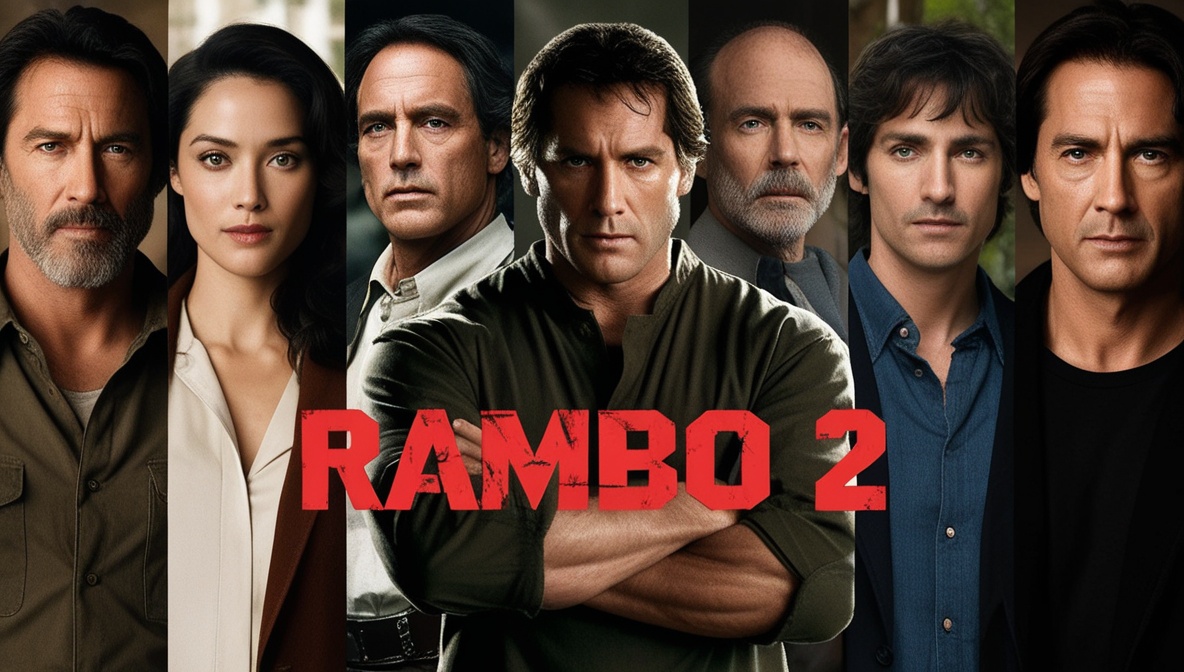
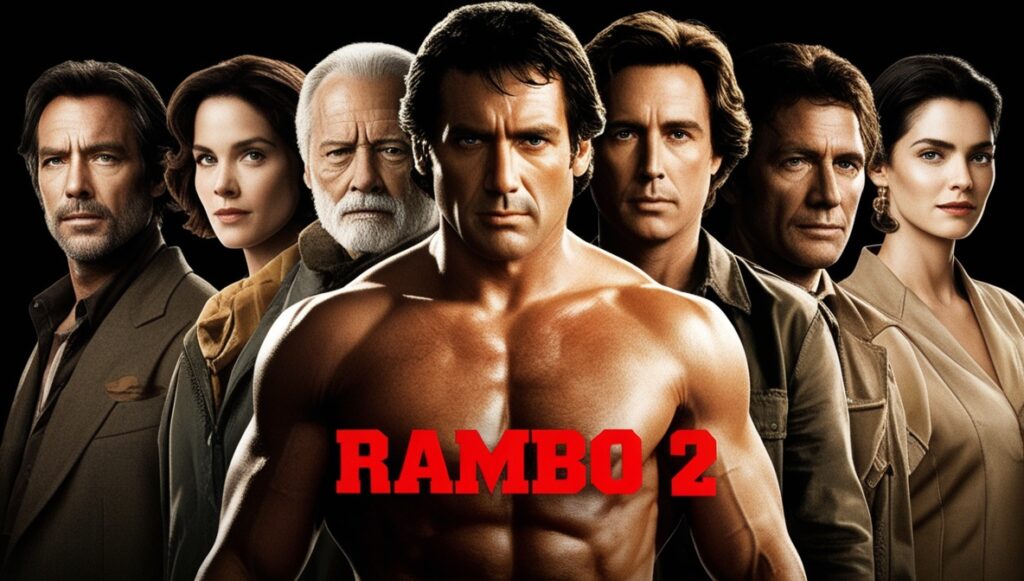
Rambo 2 Cast: Every Face Behind the Film That Defined an Era
If you were anywhere near a movie theatre in the summer of 1985, you probably remember the feeling. The poster alone said everything — a sweaty, impossibly muscular man with a headband, holding what appeared to be half an armory. Rambo: First Blood Part II arrived on May 22, 1985 like a thunderclap, and it shook American popular culture to its bones.
But a great movie — or even a wildly entertaining one — is never just one person. Behind every arrow fired and every explosion that lit up the jungle, there was a cast of actors who made this film what it became. Some were Hollywood veterans. Some were brand-new faces. Some were respected stage actors who happened to be brilliant at playing terrible people. Together, they built one of the biggest films of the decade.
Let’s sit down with all of them.
Key Facts:
| Fact | Detail |
| Film title | Rambo: First Blood Part II |
| Release date | May 22, 1985 |
| Director | George P. Cosmatos |
| Screenplay | James Cameron and Sylvester Stallone |
| Lead actor | Sylvester Stallone (John Rambo) |
| Supporting lead | Richard Crenna (Colonel Sam Trautman) |
| Female lead | Julia Nickson (Co Bao) |
| Main villain | Steven Berkoff (Lt. Col. Podovsky) |
| American antagonist | Charles Napier (Marshall Murdock) |
| Production budget | $44 million |
| Box office (worldwide) | Approximately $300 million |
| Box office rank, 1985 | Second-highest grossing film in North America |
| Filming location | Mexico and Thailand |
| Training (Stallone) | Eight months, four hours per day |
Sylvester Stallone: The Man Who Became the Myth
Here’s what you have to understand about Stallone going into this film — he was already famous. Very famous. But Rambo 2 was the moment he became something closer to a cultural symbol.
To get ready for the role, Stallone trained for eight months straight, four hours a day. He took classes in SWAT combat, archery, and wilderness survival. He worked with bodybuilding legend Franco Columbu, who drilled him through grueling supersets designed to pack on lean muscle fast. The results were genuinely hard to believe. Compared to the original First Blood, Stallone appeared to have gained nearly 20 kilograms of muscle. Audiences didn’t quite know what they were looking at.
Richard Crenna, who played his co-star Colonel Trautman across all three original Rambo films, once said he had never seen any actor work as hard as Stallone to prepare for a role. That tells you something.
The thing people often forget is that Stallone didn’t just act in this film — he rewrote it substantially. James Cameron had delivered a first draft that was more psychologically rich, more concerned with Rambo’s inner wounds. Stallone’s revisions pushed that aside and replaced it with action. Cameron later said in interviews that Stallone had essentially kept the action and removed much of the character depth, noting that he could only really distance himself from the finished film. Stallone, for his part, disagreed with that read, though he later admitted he might have shot Cameron’s script without changes.
What came out on screen was something new: not the traumatized, reluctant warrior of First Blood, but a nearly mythic figure who could take on entire armies alone. The word “Rambo” entered the English language as a noun, an adjective, even a verb. That’s a rare thing for any actor to pull off.
See also “Jimmy Bobo & Bullet to the Head: The Full Story of Hollywood’s Most Underrated Action Throwback“
Richard Crenna: The Heart of the Film Nobody Talks About
Most people focus on the explosions. But if you watch Rambo: First Blood Part II carefully, you’ll notice something. The scenes that actually carry emotion are the ones between Stallone and Richard Crenna.
Crenna played Colonel Sam Trautman in all three of the original Rambo films, and he was extraordinary in every one. What’s funny about this is that Trautman wasn’t even supposed to be Crenna’s role. Kirk Douglas was originally cast, but left the production after just one day of filming. Crenna stepped in, and the rest is history.
He was born in Los Angeles in 1926, the son of a pharmacist and a hotel manager. He started his career on radio as a kid, playing minor roles on shows that practically nobody under sixty remembers now. He worked his way through decades of television — comedy, drama, directing — before finding himself in 1982 standing across from a young Sylvester Stallone in First Blood. The role of Trautman changed his career completely. Crenna once described the feeling of being part of the Rambo franchise as being part of “the Woodstock of the 80s on the big screen.”
Off-screen, he and Stallone were close friends and renowned pranksters. Crenna once yanked Stallone’s trousers down during a live interview. Stallone responded by throwing a cream pie in Crenna’s face on another occasion. By all accounts, they were truly fond of one another.
When Crenna died of heart failure in January 2003, Stallone said something quietly devastating: that the character of Trautman had died the same day Richard Crenna did. The fourth Rambo film was dedicated to his memory. That tells you everything about what Crenna meant to the franchise — and to Stallone personally.
Julia Nickson: The Breakout Who Broke the Mold
Julia Nickson was practically unknown when she walked into auditions for the role of Co Bao. What she walked out with was the second-most prominent role in the biggest action film of 1985.
Born in Singapore to a British father and a Chinese mother, Nickson grew up straddling two very different worlds. She lost her father in a car accident when she was six. After graduating high school early, she moved to Hawaii to study at the University of Hawaii — initially planning to go into hotel management. Then she wandered past a theatre audition, crashed it on a whim, and got the part. Her entire career path changed in that moment.
She built up small TV credits, including appearances on Magnum, P.I., before a nationwide casting search for Rambo 2 brought her to Los Angeles for a screen test opposite Stallone himself. She got the role after numerous auditions, impressing producers with her poise and energy.
Co Bao is a Vietnamese freedom fighter who becomes Rambo’s guide, ally, and ultimately his brief love interest inside enemy territory. Her character’s death — shot down in a moment of cruel surprise — is one of the few moments in the film that lands with real weight. It’s the kind of loss that changes everything for Rambo’s final push, and Nickson made you feel it.
The Golden Raspberry Awards were less kind, giving her a Worst New Star nomination that year. Critics were not especially warm. But audiences responded to her, and the film itself launched her into years of steady work in Hollywood — roles alongside Pierce Brosnan, Chuck Norris, Charlton Heston, and others. She has since retired from acting, with her final major public appearance celebrating the 40th anniversary of Rambo 2 in 2025.
Charles Napier: The Perfectly Sneering Bureaucrat
Every great action film needs a villain who isn’t the fighting kind. Marshall Murdock, played by Charles Napier, is something almost more dangerous than a soldier. He’s a government pencil-pusher who is willing to leave an American soldier for dead rather than have his comfortable operation disrupted.
Napier was originally a second choice for the role. The producers initially wanted Lee Marvin, who turned it down. What they got in Napier was arguably better for the part — a man who could sweat, sneer, and panic in precisely the right proportions. He was a veteran character actor who specialized in this kind of oily authority figure, and he brought something real to a role that could easily have been cardboard.
The tension between Napier’s Murdock and Richard Crenna’s Trautman is one of the genuine pleasures of the film. Two men with totally opposite ideas of what duty means, stuck in a room together. Crenna plays a man of honor; Napier plays a man of convenience. Every scene between them crackles.
Steven Berkoff: The Villain Who Loved the Work
You want to talk about a man who seemed born to play the bad guy? Steven Berkoff is your person.
Berkoff was born in London’s East End in 1937, the son of a tailor. He trained in physical theatre in Paris, founded his own theatre company, and built a towering reputation on the stage before Hollywood came calling. He has stated plainly that he took his film villain roles specifically to fund his true passion: theatre. And yet, those roles — General Orlov in the James Bond film Octopussy, Victor Maitland in Beverly Hills Cop, and Lt. Colonel Podovsky here — are unforgettable.
As Podovsky, the Soviet commander who runs the Vietnamese prison camp where Rambo is held, Berkoff is genuinely chilling. He tortures Rambo with electrocution and other methods in some of the film’s most uncomfortable scenes. He speaks in slow, precise sentences. He is patient in the way that only someone completely confident in his power can be. And then, in the film’s final act, he takes to the air in a helicopter gunship to personally finish what he started — leading to one of cinema’s most satisfying action payoffs.
Berkoff later said he found it flattering to play evil characters, and that the best actors tended to take on villainous roles. Watching him in Rambo 2, it’s hard to argue.
Martin Kove: The Reluctant Traitor
Martin Kove plays Ericson, a CIA helicopter pilot who seems friendly enough at first. He’s the kind of guy who smiles too easily. When Murdock orders Rambo’s betrayal, Ericson goes along with it — reluctantly, but he goes along. He gets knocked out by Rambo’s machine gun for his trouble when Rambo returns victorious. It’s a small comeuppance for a small man, and Kove plays it well.
Kove’s greatest fame actually came in another franchise — he played the legendary villain Sensei John Kreese in The Karate Kid, released the very same year as Rambo 2. So 1985 was quite a year for him. Both roles leaned on the same quality: a man who looks like he’s on your side until he isn’t.
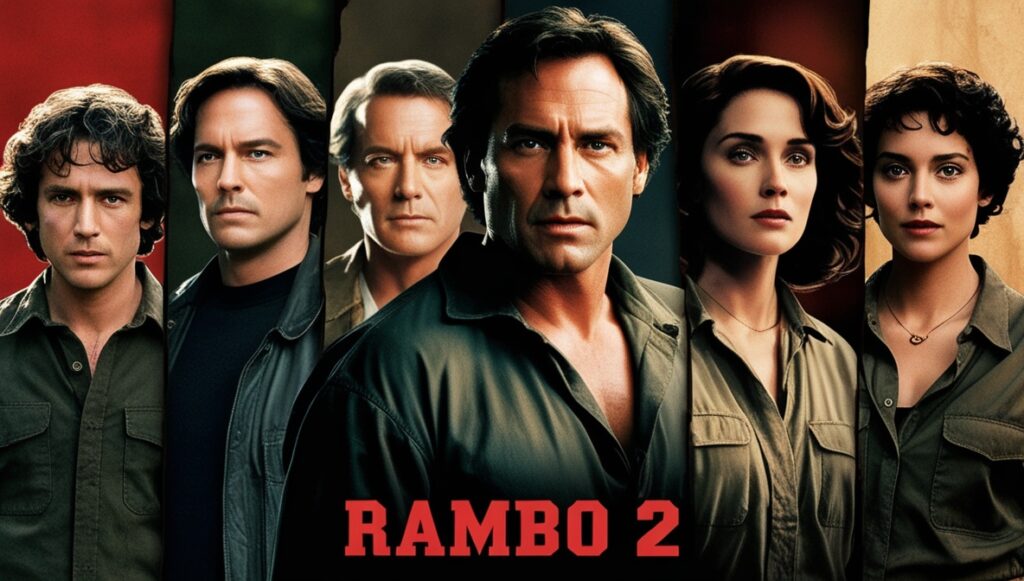
The Supporting Ensemble: Faces in the Jungle
Every jungle battle has its soldiers, and Rambo 2 had quite a few.
Andy Wood played Banks, the POW whom Rambo discovers first during his reconnaissance mission. It’s a pivotal moment in the film — the look on a man’s face when he’s told it’s 1985, that the war he has been living in for a decade is over. Viewers who caught it were moved by the quiet shock of that exchange.
Vojislav Govedarica played Yushin, Podovsky’s right-hand man and primary enforcer. George Cheung played Captain Tay, the Vietnamese military officer at the camp. Dana Lee appeared as a gunboat captain, and Steve Williams played Lifer, one of Murdock’s mercenaries who betrays Rambo at a critical moment.
The POW actors — Don Collins, Christopher Grant, John Sterlini, Alain Hocquenghem, William Rothlein — had smaller roles, but their physical presence in the camp scenes gave the mission its emotional stakes. These were the men Rambo was fighting to bring home. Without them looking genuinely worn down and frightened, the whole enterprise would have felt like an action cartoon.
Behind the Camera: The Team That Made It Work
The director was George P. Cosmatos, a Greek-born filmmaker who had previously directed Escape to Athena and Of Unknown Origin. Cosmatos understood scale and spectacle. He shot the film across Mexico and Thailand between June and August 1984, giving the jungle sequences a real oppressive heat and density.
The screenplay credit goes to both James Cameron and Stallone, though as we’ve discussed, the finished film was substantially shaped by Stallone’s rewrites. Cameron wrote the draft while simultaneously working on Aliens and polishing The Terminator — a remarkable period of creative intensity from a filmmaker who would later define blockbuster cinema.
Jerry Goldsmith composed the score, giving the film its pounding, muscular sound. Cinematographer Jack Cardiff — a true legend who had shot The African Queen and The Red Shoes — brought a striking visual quality to the jungle sequences.
One tragic note: the film is dedicated to Cliff Wenger Jr., a special effects technician who was accidentally killed by one of the film’s explosions during production. His name appears at the end as a reminder that behind every spectacular stunt, real people are doing genuinely dangerous work.
Box Office, Politics, and What It All Meant
Rambo: First Blood Part II earned roughly $150 million in North America alone, making it the second-highest grossing film of 1985 — trailing only Back to the Future, and just ahead of Stallone’s own Rocky IV. The fact that Stallone had two of the top three films of that year in America is almost hard to believe. Globally, the film brought in close to $300 million on a $44 million budget.
The film landed directly in the middle of Ronald Reagan’s presidency, and the fit was tight. Reagan’s America was in a mood of patriotic reassertion, and Rambo 2 gave that mood a muscular, cinematic form. Reagan himself referenced the film in speeches. After the 1985 Beirut hostage crisis, he joked at a press conference that after seeing Rambo the previous night, he knew exactly what to do next time. A word was coined for a certain kind of aggressive American bravado: “Ramboism.”
Critics were not kind. The Razzie Awards nominated the film seven times. Academic analysts noted the film’s oversimplified view of the Vietnam War and its broad-strokes politics. Many Vietnam veterans had complex feelings about it — some felt represented, even vindicated; others felt the film distorted what they had actually lived through.
All of these things can be true at once. The film meant different things to different people, and that tension is part of why people are still talking about it.
The Legacy of These Performances
Something interesting happens when you look at the cast of Rambo 2 forty years later. Almost all of them had careers that outlasted their moments here. Crenna worked steadily until his death in 2003. Berkoff continued his theatre work and film appearances well into his eighties. Nickson built decades of television work. Napier remained a beloved character actor for years. Kove found a whole new generation of fans through the Cobra Kai TV series, reprising his Karate Kid villain role.
And Stallone himself kept going. Rambo 2 defined him for a generation, but it didn’t trap him — not permanently. He directed the 2008 Rambo (simply titled Rambo), which was brutal and grim and unexpectedly praised. He created The Expendables franchise. He received an Academy Award nomination — again, as Rocky Balboa — in Creed in 2015.
The cast of Rambo 2 wasn’t made up of disposable pieces. These were working actors doing their jobs inside a film that happened to land at exactly the right cultural moment and become enormous.
Final Thoughts
There’s a temptation to look back at a film like Rambo: First Blood Part II and dismiss it as pure product — loud, simple, politically convenient. And it’s true that the movie is those things, at least partly.
But there’s something else in it too. The performances are real. Stallone’s physical dedication was genuine. Crenna brought warmth and dignity to every scene he appeared in. Julia Nickson made you care about a character who the film’s structure was always going to take away from you. Berkoff gave you a villain worth fearing. Napier gave you someone to deeply dislike without ever lifting a weapon.
The people in this film showed up and did their work with full commitment, in a production that was physically demanding, filmed in tropical heat, built around one of the biggest stars in the world at the peak of his fame. Whatever you think of the politics or the body count, these performances deserve their place in the story of 1980s cinema.
Forty years on, some of these actors are still working. Some have gone. But the film they made together is still right there whenever you need it — a perfect, noisy, uncomplicated thrill that somehow refuses to get old.
FAQs
1. Who played John Rambo in Rambo: First Blood Part II?
Sylvester Stallone played John Rambo, the Vietnam veteran turned reluctant warrior. He also co-wrote the screenplay with James Cameron and had significant creative control over the final product.
2. Who played Colonel Trautman, and what was his background?
Richard Crenna played Colonel Sam Trautman, Rambo’s former commanding officer. Crenna was a veteran American actor with roots in radio and television comedy before becoming a dramatic film presence. He was born in Los Angeles in 1926 and passed away in January 2003.
3. How did Richard Crenna originally get the Trautman role?
Kirk Douglas was cast first and walked off the production after one day. Crenna stepped in and the role defined the second chapter of his long career. He went on to play Trautman in all three original Rambo films.
4. Who was Julia Nickson and how did she get cast?
Julia Nickson is a Singapore-born actress who had built small television credits before a nationwide casting search brought her to audition in Los Angeles. After multiple auditions and a screen test with Stallone, she won the role of Co Bao.
5. Who was the main villain in Rambo 2?
The primary villain was Lt. Colonel Podovsky, played by English actor Steven Berkoff. He was a Soviet commander overseeing the Vietnamese prison camp. He tortured Rambo before being killed in the film’s final helicopter confrontation.
6. What was Steven Berkoff known for besides Rambo 2?
Berkoff was known for several major villain roles across this same era — General Orlov in Octopussy (1983) and Victor Maitland in Beverly Hills Cop (1984). He is equally distinguished as a playwright and theatre director, having founded his own company and written many influential stage works.
7. Who played the corrupt American official Marshall Murdock?
Charles Napier played Marshall Murdock, the bureaucratic CIA operative who betrays Rambo. Lee Marvin was originally offered the role but declined. Napier was a veteran character actor known for playing authority figures with a distinctly untrustworthy quality.
8. What role did Martin Kove play?
Martin Kove played Ericson, a CIA helicopter pilot who initially appears friendly but goes along with Murdock’s order to abandon Rambo behind enemy lines. He is best known for playing villainous Sensei Kreese in The Karate Kid, also released in 1985.
9. Did James Cameron really write the script for Rambo 2?
Cameron wrote the first draft while simultaneously working on Aliens and The Terminator. However, Stallone rewrote the script significantly — removing much of the psychological depth and adding more direct action. Cameron later stated publicly that the finished film was substantially different from what he wrote, and that Stallone had added the political dimension while he had focused on character and action.
10. How much did Stallone train for this film?
He trained for eight months at four hours per day. He worked with Franco Columbu, a two-time Mr. Olympia winner, on intensive superset training to build muscle. He also completed courses in SWAT combat, archery, and survival skills.
11. Was Dolph Lundgren originally cast in Rambo 2?
Yes — Dolph Lundgren was initially signed to play Lt. Colonel Podovsky. When Stallone realized Lundgren was also going to appear in Rocky IV, which was filming around the same time, they paid off his contract and cast Steven Berkoff instead.
12. How successful was Rambo 2 at the box office?
It was the second-highest grossing film in North America in 1985, earning over $150 million domestically. Globally, it brought in close to $300 million on a $44 million budget — one of the biggest returns on investment in Hollywood that year.
13. Did President Reagan really mention Rambo in public speeches?
Yes. After a hostage crisis in Beirut in 1985, Reagan joked at a press conference that after watching Rambo the night before, he knew what to do the next time something like that happened. He also referenced the film in speeches about tax reform and foreign policy. The nickname “Ronbo” became popular in political cartoons.
14. Was Rambo 2 shot in Vietnam?
No. Production took place in Mexico (primarily the state of Guerrero) and Thailand between June and August 1984. These locations were used to recreate the appearance of Vietnamese jungle terrain.
15. What happened to the cast member who died during production?
Cliff Wenger Jr. was a special effects technician who was accidentally killed by one of the film’s explosions during filming. The completed film carries a dedication to his memory in the closing credits — a quiet and important acknowledgment of the human cost behind the spectacle.
Every story matters—discover them all with Daily Narrative.