Civil War (2024) Film Reviews: What the Film Actually Is, What It Isn’t, and Why Everyone’s Still Arguing About It
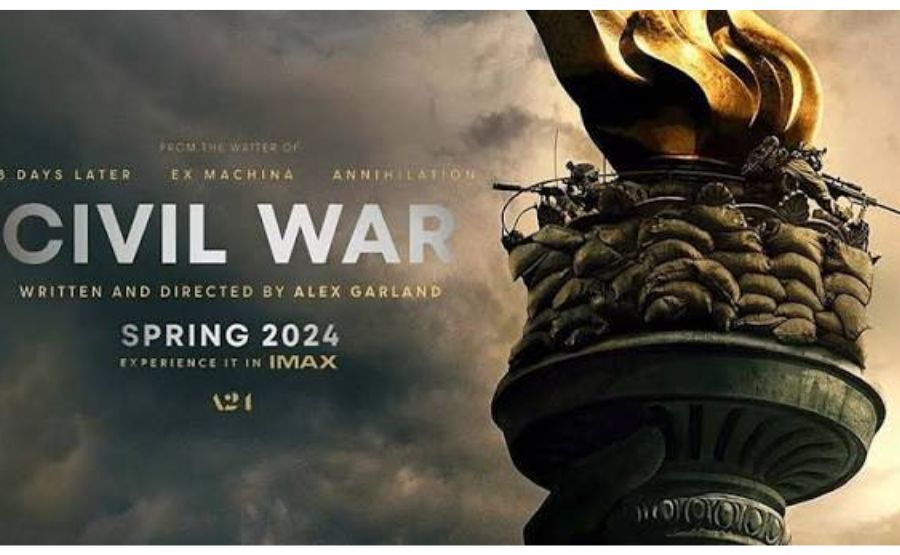
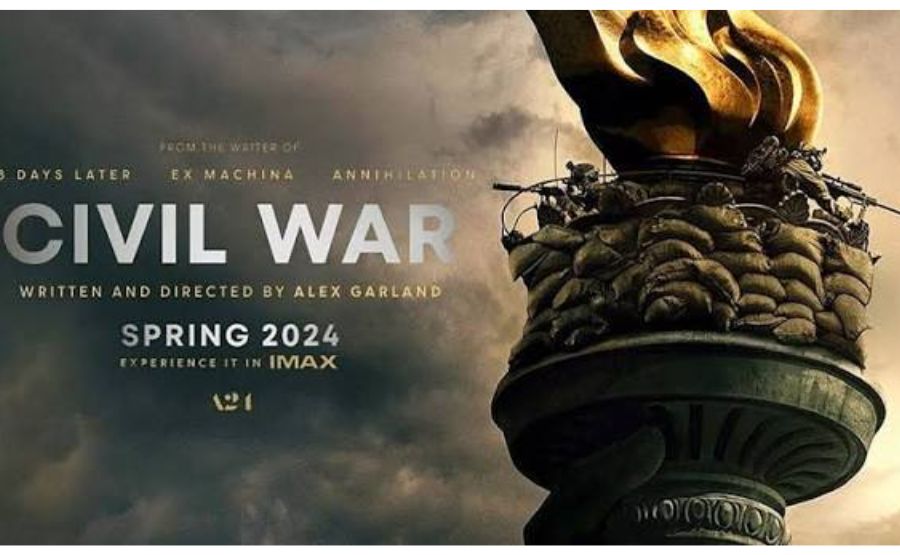
Few movies released in recent years managed to do what Alex Garland’s Civil War pulled off — fill seats, rattle nerves, divide critics right down the middle, and start arguments that had nothing to do with the story onscreen. It’s a film about journalists covering a war. It’s also a film people have been unable to stop talking about. That alone can teach you something valuable.
Let’s slow down and actually look at what’s here.
Key Facts
| Detail | Info |
| Title | Civil War |
| Director / Writer | Alex Garland |
| Release Date | April 12, 2024 (wide US release) |
| World Premiere | SXSW, March 14, 2024 |
| Distributor | A24 (US), Entertainment Film (UK) |
| Budget | $50 million (A24’s most expensive at time of release) |
| Global Box Office | ~$127 million |
| Opening Weekend | $25.7 million — A24’s biggest-ever opening |
| Runtime | 1 hour 49 minutes |
| Rating | R |
| Lead Cast | Jesse Plemons, Nick Offerman, Stephen McKinley Henderson, Wagner Moura, Kirsten Dunst, and Cailee Spaeny |
| Cinematographer | Rob Hardy |
| Score | Ben Salisbury & Geoff Barrow |
| Rotten Tomatoes | Generally positive critical reception |
The Setup: What Actually Happens in This Film
The US is engaged in internal conflict.A president — played by Nick Offerman — is serving a third term, having disbanded the FBI along the way. Three secessionist movements are closing in on Washington, D.C. The biggest of them calls itself the Western Forces, a strange and deliberately provocative alliance of California and Texas.
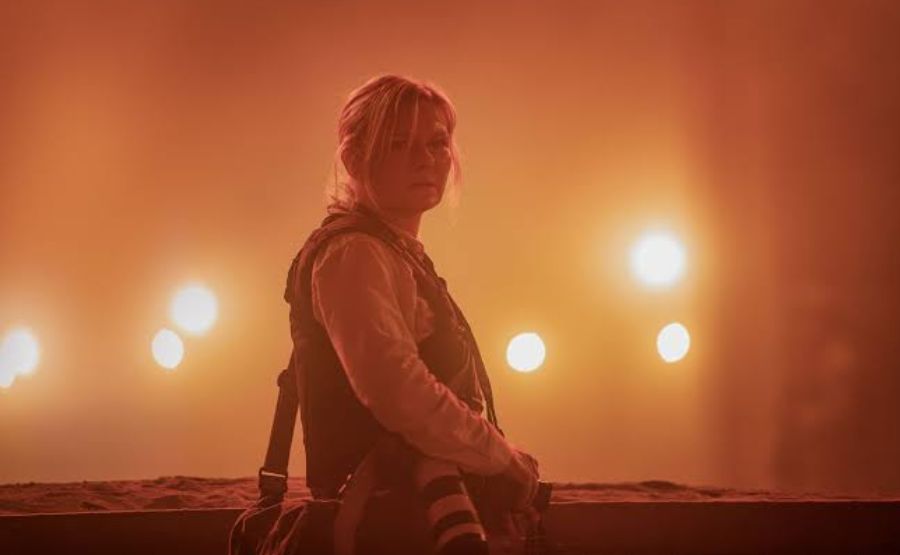
Into this chaos walk four journalists. Lee (Kirsten Dunst) is a legendary war photographer, the kind who has spent decades capturing horror in other countries and is now watching it happen at home. Joel (Wagner Moura) is her Reuters colleague — confident, a little reckless, always chasing the next shot. Sammy (Stephen McKinley Henderson) is an older print journalist from what remains of the New York Times, walking slowly with a cane and full of quiet wisdom. And then there’s Jessie (Cailee Spaeny), young, wide-eyed, and desperately eager to become something like Lee.
The four of them pack into a car and drive from New York City to Washington, D.C. — roughly 500 miles through a country that no longer feels like any country they recognize. That road trip is the film.
It is not an explanation of the war. It is not a political argument. It is a series of encounters — some quiet and haunting, some violent enough to make you flinch in your seat — that piece together a portrait of what collapse actually looks and feels like up close.
What the Film Does Brilliantly
Here’s where you have to be honest with yourself as a viewer.
Technically, Civil War is stunning. Cinematographer Rob Hardy drew inspiration from wartime newsreel footage. He wanted the camera to feel like it was there with the journalists, not floating above them like some omniscient god. He and Garland rigged cars with up to twelve cameras at once, carefully arranged so no lens could see another, letting actors play entire scenes in motion without stopping. The result is a kind of trapped, pressurized intimacy. You feel stuck in that car with these people.
The sound design is extraordinary. Gunshots don’t sound like movie gunshots — they’re sharp and wrong and too loud, the kind of sound that makes your shoulders go up involuntarily. Bullets feel like they’re coming from different directions, often off-screen, and that spatial disorientation is a deliberate choice. It tells you what war journalists actually know: danger doesn’t announce itself. It just arrives.
Kirsten Dunst gives one of her finest performances. Lee is not a warm character. She’s been doing this for so long that she’s more camera than person in some scenes. Her eyes move across a battle the way a naturalist watches animals — studying, noting, recording, feeling almost nothing. Dunst captures something rare: a human being who has built a wall so high she’s forgotten the wall is there. She’s compelling precisely because she’s not immediately likable.
And then there’s Jesse Plemons in an uncredited cameo that might be the most talked-about scene in the film. He plays a militia soldier at what appears to be a mass grave site, interrogating the journalists with a terrifying calm politeness.”What kind of American are you?” he says bluntly. Based on his responses, he shoots people.Plemons plays the scene with such quiet menace that the theater goes utterly silent. It is the film at its most honest about what breakdown looks like — not grand, not ideological, just a man with a gun and a worldview that has curdled into something monstrous.
The Controversy Everyone Keeps Having
Here is where things get messy, and where reasonable people genuinely disagree.
Garland made a deliberate choice: he refused to explain the war’s politics. He didn’t tell us which side was right. He didn’t draw obvious parallels to today’s political parties. California and Texas — two states that couldn’t be more different politically in real life — are allies in his film. The president (Offerman) disbanded the FBI and is on his third term, which carries some echoes, but Garland doesn’t press it. He leaves the ideological content almost entirely blank.
For some viewers and critics, that was the whole point. Garland said at SXSW that he was trying to spark a conversation about how political divisiveness works — how people stop listening to each other, how rhetoric turns neighbors into enemies. He argued that making one side clearly “right” would have just confirmed whatever the viewer already believed, and sent them home feeling validated rather than challenged.
For other critics — and some fairly prominent ones — that choice felt cowardly. If you’re going to make a film called Civil War and release it in a U.S. election year, the argument goes, you owe it to your audience to say something about what’s actually happening. A film that carefully avoids assigning blame doesn’t make a statement; it just makes noise.
Both sides of that argument have real weight. That’s what makes the conversation interesting.
Cailee Spaeny: The Character Who Actually Changes
One of the film’s quieter achievements is the arc it draws for Jessie.
At the start, she’s the audience surrogate — nervous, overwhelmed, photographing things tentatively. By the end, she’s doing something that should disturb us. Jessie uses black-and-white film, a throwback to old-school photojournalism. As the film moves forward, her hesitation disappears. She becomes faster, more certain, more willing to step closer to violence to get the shot. The camera becomes a way of separating herself from what she’s seeing, a trick she’s learned from Lee.
The question the film leaves hanging: is that transformation growth, or is it damage? Did she become a great war journalist, or did she become someone who stopped seeing people as people? Spaeny plays it so that you genuinely don’t know. That ambiguity is one of the film’s most honest moves.
The Journalism Question Nobody Agrees On
Civil War is, at its core, a meditation on what photojournalists do and what it costs them.
Lee’s professional mantra is stated clearly: “We record, so other people ask.” The journalists don’t intervene. They don’t take sides. They document. Lee frames this as integrity — as the highest form of the craft. But the film keeps quietly testing that belief. When the cameras finally come down and the journalists are forced to act as human beings rather than observers, the movie shifts. And it asks, without quite spelling it out: is there a moment when staying neutral becomes its own kind of choice?
Real war photographers have grappled with exactly that question for decades. The famous Kevin Carter photograph of a vulture watching a starving child won a Pulitzer Prize and contributed to Carter’s suicide. The question of what you owe the person in your viewfinder doesn’t have a clean answer, and Civil War doesn’t pretend it does.
The Numbers Tell Their Own Story
When Civil War opened to $25.7 million in its first weekend, it shattered every record A24 had previously set. This was a studio whose previous biggest opening was Hereditary — a horror film that opened to $13.6 million. Civil War nearly doubled that.
By the time it finished its global run, the film had earned around $127 million worldwide on a $50 million budget. It became A24’s second-highest-grossing film ever, behind only Everything Everywhere All At Once. For a non-franchise, non-superhero, R-rated, politically provocative film with no clear heroes, that is genuinely remarkable.
The audience skewed male, roughly 63%, and younger — 57% were between 18 and 34. IMAX screens contributed more than 16% of the opening weekend gross, which tells you people weren’t treating this like a small indie film to watch on a laptop. They went to experience it physically, at volume, in the dark.
The “B-” CinemaScore it received — a measure of audience satisfaction collected as people leave theaters — would normally spell disaster for word-of-mouth. For A24, which has built a reputation on films that divide and unsettle, it was almost a badge of honor.
Behind the Camera: Craft Worth Knowing About
A few production details that add texture to the experience:
Principal photography began in Atlanta in March 2022 under the code name Road Trip. Garland and Hardy drew on the work of photographer William Eggleston — who helped make color photography a serious art form — as a visual reference. The film’s Washington, D.C. finale was actually shot in Stone Mountain, Georgia, with White House scenes filmed at Tyler Perry Studios in Atlanta.
That sprawling battle sequence in the D.C. streets required months of planning. Garland, Hardy, the production designer, VFX supervisor, military supervisor, and stunt coordinator all met repeatedly to work out how to make it feel real and visceral without becoming cartoonish. A real helicopter was used for most of the aerial shots.
The Christmas Wonderland decorations that appear in the sniper scene? Not a production design choice. Garland found them already there — someone had built a seasonal attraction and abandoned it when it failed financially. He kept them. “If you haven’t put away the Christmas decorations,” said he, “clearly something isn’t right.”
That detail says a lot about how the film works. The strangeness of collapse isn’t always dramatic. Sometimes it’s just wrong details left in the wrong places, accumulating quietly until the world stops making sense.
Misconceptions Worth Clearing Up
“It’s a movie about the left vs. the right.” It really isn’t. Garland deliberately scrambled the political geography. The clearest indication that he is not attempting to organize his fight onto existing partisan lines is the Western Forces coalition of Texas and California.Viewers who saw it as a Trump parable and viewers who saw it as anti-government-left propaganda were both reading in what they brought with them.
“It glorifies war.” This one is actually the opposite of what the film does. Every moment of violence in Civil War is presented without glamour. Bodies are real. Injuries don’t disappear. The fear is constant and grinding. The film’s camera never cheers. It just watches. If anything, that refusal to make violence exciting is the film’s most consistent moral commitment.
“It has nothing to say.” This may be the most common complaint, and it’s partly earned — the film is deliberately elliptical. But the question it keeps asking, about what we owe each other when institutions collapse, about whether the act of witnessing can be a form of complicity, about what happens to a person who trains themselves not to feel — those aren’t nothing. They’re just harder to debate than a bumper sticker.
What the Film Gets Right About Today
Garland said something at SXSW that stuck with many who heard it. He argued that no country is immune to collapse. That history doesn’t grant exceptions based on geography or national pride. That the habits that hold societies together — listening, trusting institutions, seeing political opponents as still-human — can erode faster than anyone expects.
He made that point by refusing to explain which side the audience should root for. Whether or not you think that was brave or evasive, it does force a question: why does it feel so important to you to know which side is right? What does that urgency tell you about how you already think about your neighbors?
That’s a genuinely uncomfortable place for a movie to leave you.
The Ending: What Happens and What It Means
Without spelling out every detail: the film arrives at the White House. There’s a battle. The president is found. And in the final moments, Jessie takes the photograph that will presumably define her career — the one that Lee, earlier in the film, said she’d recognize when it came.
The film ends on that image. No resolution. No message. Just a picture being taken, and the silence after.
It’s either a hollow ending or a devastating one, depending on whether you think the film earned the weight it places on that final act of documentation. Many viewers felt it did. Quite a few felt cheated.
FAQs
1. Is Civil War a political film?
It’s set against a political backdrop, but Garland deliberately avoided making it partisan. The film is less about who’s right and more about what collapse feels like from the ground level, specifically from the perspective of journalists trying to document it without choosing sides.
2. What is the alliance between Texas and California, and who are the Western Forces?
The film doesn’t fully explain. The alliance of two politically opposite states is an intentional provocation — Garland wanted to signal that this isn’t a simple red-vs.-blue story. The Western Forces seem to be opposing an authoritarian president, but the details are left vague on purpose.
3. How did Kirsten Dunst prepare for the role?
She spent months carrying a camera constantly — photographing her kids, holiday gatherings, anything nearby. She worked with a professional photographer in Austin, Texas, and specifically feared looking inexperienced with the camera. Her photographer friends later told her she’d nailed it.
4. What’s the Jesse Plemons scene about?
Plemons plays an unnamed racist militia leader holding journalists at a mass grave site. He asks each captive “What kind of American are you?” and executes them based on their answers. It’s the film’s most explicit portrait of how ideology curdles into violence when no one’s watching.
5. Is the film based on any real war or historical event?
No. It’s an original, fictional scenario set in a near-future America. Garland described it as a sci-fi allegory for political polarization, not a dramatization of any specific historical or current event.
6. Why didn’t the film explain the cause of the war?
Garland said this was intentional. He believed that explaining the political details would let viewers simply agree or disagree with the factions, validating whatever they already thought. By leaving it blank, he hoped to force viewers to sit with the discomfort of not knowing who to root for.
7. How did the film do at the box office?
Very well. It opened to $25.7 million — A24’s biggest opening weekend ever — and went on to earn around $127 million globally on a $50 million budget. It’s the second-highest-grossing A24 film of all time.
8. What was the controversy around the AI-generated marketing images?
Shortly after release, A24 posted AI-generated images on social media showing American cities in ruins. Several were criticized for being inaccurate — one of Chicago showed buildings incorrectly positioned. Critics saw it as lazy marketing that cheapened a serious film.
9. Is Cailee Spaeny’s character the real protagonist?
Arguably yes. While Lee is the film’s moral anchor, Jessie is the character who actually changes — from nervous outsider to hardened documentarian. Her arc carries the film’s most troubling question about what becoming good at war photography costs a person.
10. What is the film actually saying about journalism?
It raises more questions than it answers. It presents journalists as people who believe their job is to document without judging — but it also quietly questions whether that neutrality is truly neutral, or whether staying behind the camera is itself a moral choice.
11. How does the film compare to Garland’s earlier work like Ex Machina or Annihilation?
It’s different in tone and scale. Those films are quieter and more contained. Civil War is louder, more kinetic, and more deliberately provocative in its subject matter. Critics were divided on whether the expanded scale helped or hurt his signature style.
12. Was the film shot where the story takes place?
Not exactly. Most Washington, D.C. scenes were filmed in Stone Mountain, Georgia. The White House sequences were shot at Tyler Perry Studios in Atlanta. The production used multiple states and locations to build the film’s fractured American geography.
13. Does the film have a clear message about gun violence or war?
Not a simple one.Instead of being exciting, the movie portrays violence as ugly, grating, and pointless. But it doesn’t preach. Garland said he wanted to start conversations, not deliver conclusions.
14. Should I watch it if I’m politically exhausted?
Possibly, precisely because it doesn’t take sides. If you’re tired of things that tell you what to think, Civil War refuses to. Whether that’s satisfying or frustrating depends on the viewer.
15. Is there a sequel planned?
Not as of current reporting. Garland announced intentions to step back from directing after this film (though he later walked that back), and no sequel has been announced.
Every story matters—discover them all with Daily Narrative.