PaybyPlatema: The Quiet Little System That Changed How Massachusetts Drivers Pay Tolls
Let me ask you something. When was the last time you actually stopped your car to hand someone cash for a toll in Massachusetts? If you’re drawing a blank, that’s not an accident. That whole experience quietly disappeared, and Pay By Plate MA is a big part of why.
I want to walk you through what this system actually is, how it really works behind the scenes, and a few things you genuinely need to watch out for, because there’s a scam angle here that trips up a lot of good people.
Key Facts
| Detail | Information |
| What it is | An electronic toll payment option under Massachusetts’ EZDriveMA program |
| Run by | The Massachusetts Department of Transportation, known as MassDOT |
| How it identifies you | Overhead cameras photograph your license plate as you drive through toll points |
| No booths, no stopping | Tolls are collected as you drive at normal speed, no physical booths remain |
| Two main account types | Prepaid (load money ahead of time) or Postpaid (pay after tolls accrue) |
| No account option | If you never register, you’ll get a mailed invoice sent to the vehicle’s registered owner |
| Roads covered | Mass Turnpike (I-90), Tobin Memorial Bridge, Sumner Tunnel, Callahan Tunnel, Ted Williams Tunnel |
| Cost difference | E-ZPass transponder users typically pay less than Pay By Plate invoice users |
| Invoice timing | Usually arrives around 7 to 10 business days after your trip |
| Late payment penalties | Extra $1 fee after 30 days, another $1 after 60 days, and a $20 RMV fee plus registration issues past 90 days |
| Payment methods | Credit or debit card, bank transfer, digital wallets, or cash at service centers |
| Official website | www.paybyplatema.com, managed through EZDriveMA |
| Big scam warning | Fake texts claiming unpaid tolls are common; EZDriveMA never texts you about bills |
Alright, now let’s slow down and really get into how all of this actually fits together.
Why Massachusetts Ditched the Toll Booth
For most of its history, Massachusetts collected tolls the old-fashioned way.You slowed down, rolled down your window, and either gave money to someone seated in a little booth or threw pennies into a basket. Technically, it worked, but it was a mess.
Rush hour turned toll plazas into bottlenecks. Cars backed up for miles some mornings, engines idling, drivers frustrated, exhaust piling up in the air. Anyone who commuted through Boston regularly has a story about sitting in one of those lines longer than they’d like to admit.
At some point, state transportation officials decided enough was enough. Camera technology had gotten good enough, and license plate recognition had matured to the point where a car could be identified accurately just from a quick photo taken at highway speed. That technology became the backbone of what Massachusetts eventually rolled out statewide.
What EZDriveMA Actually Is, and Where Pay By Plate Fits In
Here’s something that trips people up. Pay By Plate MA isn’t its own separate company or app floating out there on its own. It’s one half of a bigger program called EZDriveMA, which MassDOT runs.
The other half is the more familiar E-ZPass MA, where you get a little transponder that sits on your windshield and talks to the tolling equipment as you pass under it. Pay By Plate is what happens when you don’t have one of those transponders, either because you chose not to get one or because you’re just visiting from out of state.
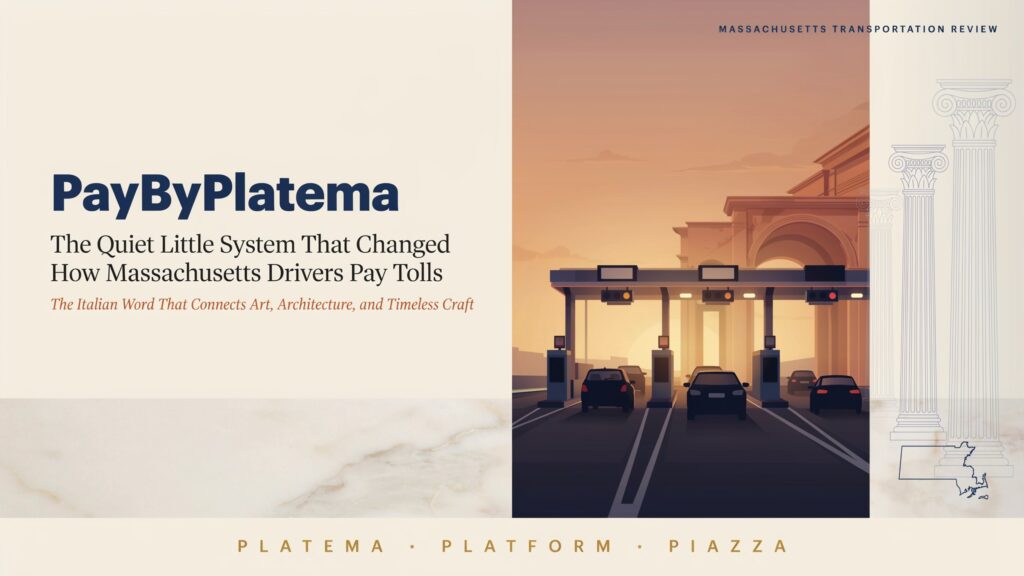
Both halves rely on the exact same overhead camera gantries positioned above the highway. The camera doesn’t really care whether you have a transponder or not, it’s just watching. If it sees a transponder signal, it charges that account automatically. If it doesn’t, it photographs your plate instead and starts the Pay By Plate process.
How the Camera System Actually Works, Step by Step
I think it helps to picture this happening in real time. You drive under one of these overhead structures at highway speed, no braking required at all. A high-speed camera snaps a clear image of your license plate as you pass beneath it.
That image gets run through a recognition system that reads the plate number and matches it against records. If your plate is tied to a registered account, prepaid or postpaid, the toll amount simply gets deducted, quietly, with zero effort on your part.
If there’s no account linked to that plate, the system instead pulls the vehicle’s registration information and mails an invoice to whoever the car is registered to. That invoice typically shows up around a week or two after your trip, giving you a written record along with instructions on how to pay it.
Setting Up an Account, and Why Some People Bother
Not everyone registers for an account, and that’s perfectly fine if you rarely drive through Massachusetts. But if you’re a regular commuter, having an account genuinely makes life easier.
Setting one up involves visiting the official site, agreeing to the terms, and entering your contact details along with a short security PIN. From there you add your vehicle information, plate number, make, model, and choose whether you want a prepaid or postpaid setup.
Prepaid functions similarly to a toll gift card.. You load a starting amount, usually a minimum of twenty dollars, and each toll gets deducted from that balance automatically. When the balance runs low, you can top it up manually or set automatic refills so you never have to think about it again.
Postpaid flips that order around, letting tolls accumulate first and then billing you afterward, similar to a regular monthly account. Which one fits you really depends on whether you like seeing your balance drop in real time or prefer to just get billed later and move on with your day.
The Real Difference in Cost Between the Two Options
Here’s something worth knowing honestly upfront. If you have an actual E-ZPass transponder, you typically pay a lower toll rate than someone using Pay By Plate without one.
That’s because the camera-only Pay By Plate process costs the state more to administer, since somebody has to process that plate image, generate an invoice, and mail it out. Those extra steps get reflected in a slightly higher toll charge compared to the transponder rate.
For someone who drives through Massachusetts constantly, that price gap adds up over a year. For someone passing through just once or twice, it usually isn’t worth the hassle of getting a transponder just to save a small amount here and there.
A Small Typo Can Cause a Big Headache
I came across a small but very real story that stuck with me. Someone registering their account accidentally put a space in the wrong spot while typing their license plate number. The system accepted it without complaint, but because the plate didn’t match perfectly, their tolls never linked to their new account.
Instead, they kept getting separate mailed invoices as if they had no account at all, completely unaware anything was wrong until they eventually called support to sort it out. It’s a tiny mistake with a genuinely annoying consequence, and it’s exactly the kind of thing that makes double-checking your plate number, character by character, actually worth the extra thirty seconds.
The Scam You Really Need to Know About
Now here’s the part I think matters most, and I want to be really direct about it. Starting around 2024 and continuing well into 2025, a wave of fake text messages started circulating claiming to be from EZDriveMA.
These texts usually say something like your vehicle has an unpaid toll bill, often a suspiciously small amount like $6.99, and that you need to click a link immediately to avoid late fees. It sounds urgent. It sounds official. It is neither of those things.
MassDOT has said this plainly and repeatedly: EZDriveMA never requests payment through text messages. Ever. If you get a text like this, it did not come from the real toll agency, no matter how convincing the wording sounds.
A computer science professor who studies this kind of thing pointed out something clever, that legitimate Massachusetts government links would end in a recognizable official pattern, while scam links often look slightly off if you actually look closely at the web address. But honestly, you shouldn’t need to become a detective every time your phone buzzes. The simplest and safest move is just this: never click a link in an unexpected toll text, ever, no matter what it claims.
If you’re ever unsure whether you owe money, go straight to the official site yourself by typing it in, or call the real customer service number directly. Don’t use any link or number sent to you out of the blue. That one habit alone protects you from almost every version of this scam.
What Happens If You Genuinely Ignore a Real Invoice
Let’s say a real, legitimate Pay By Plate invoice does show up in your mailbox and you just let it sit there. That’s a different situation from the scam texts, and it does carry real consequences over time.
After about thirty days without payment, a small additional fee gets tacked on, roughly a dollar. Another dollar gets added around the sixty day mark if it’s still unpaid. Once you cross ninety days, things get more serious, with a twenty dollar fee from the Registry of Motor Vehicles and potential trouble renewing your vehicle’s registration.
None of those penalties are enormous individually, but they’re a genuine hassle nobody needs, and they’re completely avoidable just by paying a real invoice within its window or setting up autopay so you never have to remember at all.
The Genuine Benefits People Actually Notice
Setting scams and typos aside for a second, this system really has changed daily driving in Massachusetts for the better in a few clear ways. Traffic through former toll plazas moves dramatically faster now, since nobody needs to slow down or stop at all.
Commutes that used to include a stressful crawl through a toll backup now flow at highway speed the entire way through. That’s not a small thing if you’re doing that drive twice a day, five days a week, for years.
There’s also something nice about not needing exact change anymore, or fumbling for a card while merging back into traffic. The whole toll-paying moment has basically disappeared from the actual experience of driving, which honestly, most people don’t miss one bit.
The Fair Challenges Worth Mentioning
This isn’t ideal, and I don’t want to make it seem that way.Some drivers genuinely dislike not having advance warning about exactly how much they’re being charged in the moment, since the invoice or account deduction happens somewhat invisibly compared to seeing a number at a booth.
Out-of-state visitors sometimes get caught off guard entirely, driving through without realizing tolls were even being collected, then getting a surprise invoice weeks later. And the price gap between transponder rates and camera-only rates does feel a little unfair to occasional visitors who had no easy way to get a transponder before their trip.
The scam situation is also a real, ongoing challenge on its own. Even though MassDOT keeps warning people, new waves of these fake texts keep resurfacing, especially around busy travel periods like holidays, which tells you scammers know exactly when people are more likely to be distracted and quick to click.
Where This Kind of System Seems to Be Heading
Massachusetts isn’t alone here. Plenty of other states have moved toward similar camera-based, cashless tolling in recent years, so this whole approach seems to be the direction most modern highway systems are heading toward long term.
It wouldn’t be surprising to see even smoother processes down the road, maybe faster invoice turnaround, clearer text-based systems that are actually secure and verified somehow, or tighter integration between states so a single account could follow you smoothly across state lines without separate invoices piling up.
Security around these accounts will likely keep tightening too, especially as scam texts keep evolving. Features like two-factor login verification are already being encouraged, and it makes sense that more protections like that become standard rather than optional as time goes on.
Final Thoughts
There’s something quietly satisfying about a system that mostly just works without you noticing it. Pay By Plate MA is exactly that kind of quiet background technology, doing its job every time you cross a bridge or drive through a tunnel without asking much of you at all.
Just remember the one thing that actually matters for your safety here. The real system never texts you demanding urgent payment. If you ever get a message like that, take a breath, don’t click anything, and go check things out directly through the official channels instead. A little bit of calm skepticism goes a long way, and it’s really the only thing standing between you and a scam that’s been fooling far too many good, busy people.
FAQs
1.What exactly is Pay By Plate MA?
It’s the part of Massachusetts’ electronic tolling system that charges drivers based on a photograph of their license plate, used when there’s no E-ZPass transponder linked to that vehicle.
2.Do I have to sign up for an account to use it?
No. If you don’t register, you’ll simply receive a mailed invoice after your trip based on your plate and registration information.
3.Is Pay By Plate the same thing as E-ZPass MA?
No, they’re two different options under the same overall EZDriveMA program. E-ZPass uses a physical transponder, while Pay By Plate relies entirely on camera images.
4.Why does Pay By Plate sometimes cost more than E-ZPass?
The invoicing and camera-processing steps cost more to administer, so that extra cost typically gets reflected in a slightly higher toll rate compared to transponder users.
5.How long after my trip will I get an invoice?
Usually somewhere around seven to ten business days after you pass through a tolled area.
6.What happens if I ignore a real invoice?
Late fees start adding up gradually, roughly a dollar at thirty days and another dollar at sixty days, with more serious consequences like a Registry fee and registration issues after ninety days.
7.Is the text message asking me to pay an overdue toll real?
No. EZDriveMA has stated clearly and repeatedly that it never requests toll payments through text messages. Any text like that is a scam.
8.What should I do if I get a suspicious toll text?
Don’t click any link inside it. Delete the message, and if you’re worried you might genuinely owe something, check directly through the official website or call customer service yourself.
9.What if I already clicked a scam link?
Contact your bank or credit card company right away to secure your accounts, and consider reporting the incident through the FBI’s Internet Crime Complaint Center.
10.Can I pay with cash?
Yes, but only in person at an official EZDriveMA customer service center, not online or through the mobile app.
11.What roads does this system cover?
The Massachusetts Turnpike, the Tobin Memorial Bridge, and Boston’s Sumner, Callahan, and Ted Williams Tunnels.
12.What’s the difference between prepaid and postpaid accounts?
Prepaid requires you to load money in advance, deducting tolls automatically as you go. Postpaid lets tolls build up first, then bills you afterward.
13.I made a typo entering my license plate. What happens?
Your tolls likely won’t link properly to your account, and you may keep receiving separate invoices as if you have no account at all, so it’s worth double-checking every character carefully during setup.
14.Do out-of-state drivers need to worry about this system?
Yes. If you drive through a tolled section without a transponder from your home state’s compatible network, a camera will capture your plate and an invoice will be mailed to your vehicle’s registered address.
15.Is my personal information safe with this system?
The official system is run and encrypted by MassDOT, but you should always confirm you’re on the genuine website, since scam sites sometimes mimic the real one closely enough to fool a quick glance.
Every story matters—discover them all with Daily Narrative.